Scheduling is one of those business activities that looks simple until you are responsible for managing it.
A company may need to schedule employees, customer appointments, production jobs, deliveries, installations, service calls, meetings, equipment, and dozens of other activities. Every one of those schedules can be affected by changing priorities, employee availability, customer requests, unexpected delays, and limited resources.
For many businesses, scheduling eventually becomes a complicated puzzle.
Managers spend hours moving appointments around, checking calendars, calling employees, updating spreadsheets, and trying to determine what should happen next. Even after all that work, schedules can quickly become outdated when something unexpected happens.
Artificial intelligence is beginning to change how businesses approach this problem.
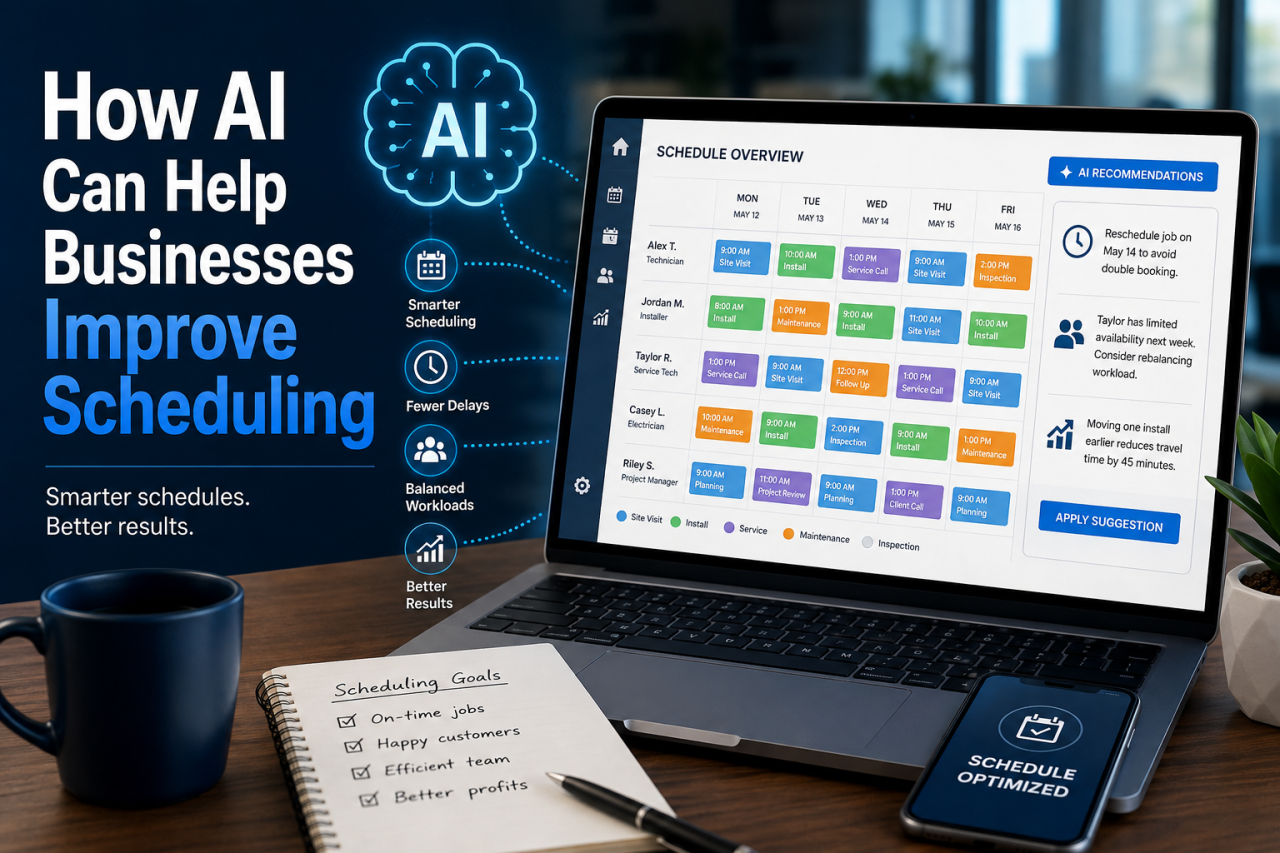
AI can help companies analyze scheduling information, identify conflicts, recommend better schedules, predict potential delays, and respond more quickly when plans change.
But that doesn’t mean businesses should simply hand their schedules over to AI.
The greatest value comes from using AI as a tool that helps employees and managers make better scheduling decisions. When implemented correctly, AI can reduce administrative work while giving businesses greater visibility into their operations.
Here’s how AI can help.
Why Business Scheduling Becomes So Complicated
A schedule is rarely just a calendar.
Consider a company that schedules field service technicians. The company might need to consider:
- Technician availability
- Employee skills and certifications
- Customer availability
- Job priority
- Estimated job duration
- Travel distance
- Equipment requirements
- Parts availability
- Previous appointments
- Emergency service requests
A manufacturing or sign company may face an entirely different collection of scheduling variables.
Production managers might need to consider machine availability, material delivery dates, employee workloads, job deadlines, installation schedules, subcontractors, and production capacity.
When businesses are small, employees can often manage these variables manually.
A manager may know everyone’s schedule and understand which employees are best suited for particular jobs. A spreadsheet, whiteboard, or shared calendar might be enough.
As the company grows, however, scheduling becomes significantly more complicated.
There are more employees, customers, projects, resources, and deadlines to coordinate.
At some point, managers can no longer keep everything in their heads.
That’s where better scheduling systems—and increasingly AI—can make a significant difference.
AI Can Analyze More Scheduling Information
One of AI’s biggest advantages is its ability to analyze large amounts of information quickly.
Traditional scheduling often requires someone to manually compare several sources of information.
A manager might look at an employee calendar, check a project deadline, review inventory, and then look at another system to determine whether equipment is available.
AI can potentially analyze all of those variables together.
For example, imagine a business needs to schedule five new jobs.
Instead of simply placing the jobs into the next available time slots, an AI-assisted scheduling system could consider factors such as employee availability, job duration, customer deadlines, resource requirements, existing workloads, and historical job performance.
The system could then recommend scheduling options that make better use of available resources.
This doesn’t necessarily mean AI makes the final decision.
Instead, it gives managers better information for making that decision.
AI Can Identify Scheduling Conflicts Earlier
Scheduling conflicts are expensive.
Two jobs may accidentally require the same equipment at the same time. An employee may be assigned to overlapping appointments. A production job may be scheduled before the required materials are expected to arrive.
Sometimes these conflicts aren’t discovered until work is about to begin.
At that point, the company has fewer options.
AI can help identify potential conflicts earlier by continuously comparing scheduling requirements.
For example, a system might recognize that a production job scheduled for Tuesday requires materials that aren’t expected until Wednesday.
Instead of waiting for Tuesday morning to discover the problem, the scheduling system could flag the issue ahead of time.
That gives the company an opportunity to move the job, expedite the materials, or adjust other parts of the schedule.
Early warnings can be extremely valuable.
The earlier a business knows about a scheduling problem, the easier it usually is to solve.
AI Can Help Predict How Long Work Will Actually Take
One of the biggest scheduling challenges is estimating job duration.
Companies frequently schedule work based on assumptions.
A certain type of project might normally be given four hours. An installation might be scheduled for one day. A service appointment might receive a two-hour window.
But actual job times can vary considerably.
AI can help businesses analyze historical data to develop better estimates.
Suppose a company has completed hundreds of similar jobs.
AI could potentially analyze factors such as:
- Original estimated hours
- Actual labor hours
- Type of work performed
- Number of employees assigned
- Equipment used
- Project complexity
- Customer type
- Location
- Previous delays
Patterns may emerge that employees wouldn’t easily recognize manually.
Perhaps a certain type of project consistently takes 20 percent longer than estimated.
That information can improve future scheduling.
Better estimates lead to more realistic schedules, which can reduce overtime, rushed work, missed deadlines, and frustrated customers.
AI Can Help Balance Employee Workloads
Poor scheduling doesn’t always mean employees have too much work.
Sometimes the problem is that work isn’t distributed effectively.
One employee might have an overloaded schedule while another has available capacity. A production department may be overwhelmed while another area is waiting for work.
AI can help managers see these workload imbalances.
A scheduling system could analyze upcoming assignments and highlight situations where employees or departments are approaching capacity.
Managers could then redistribute work before the imbalance becomes a serious problem.
This can be especially helpful for growing businesses.
As organizations become larger, managers may have less visibility into everyone’s workload.
AI can help restore some of that visibility.
AI Can Help Businesses Prioritize Work
Not every task has the same priority.
A customer emergency may need immediate attention. A high-value project may have a strict deadline. Another job may be flexible enough to move several days without causing a problem.
AI can help companies evaluate these competing priorities.
For example, a scheduling system might consider:
- Customer deadlines
- Contract commitments
- Job value
- Customer priority
- Production requirements
- Employee availability
- Dependencies between tasks
The system could then recommend which jobs should receive scheduling priority.
Again, this shouldn’t necessarily mean AI makes the decision automatically.
There may be circumstances the software doesn’t understand.
A longtime customer may have a special situation. A salesperson may know a deadline is flexible. A production manager may be aware of an equipment issue that hasn’t been entered into the system.
Human judgment still matters.
AI simply gives decision-makers another source of useful information.
AI Can Make Rescheduling Faster
Even the best schedule eventually changes.
An employee calls in sick.
A customer postpones an appointment.
A delivery doesn’t arrive.
Equipment breaks.
A project takes longer than expected.
A rush order suddenly becomes the company’s highest priority.
Traditional scheduling often requires someone to manually reorganize everything after one of these events occurs.
That can create a domino effect.
Moving one job may affect several others.
AI can help evaluate the consequences of those changes much faster.
For example, if an installation crew becomes unavailable, the system could identify affected jobs and recommend alternative crews or dates.
Instead of manually rebuilding the schedule, the manager receives possible solutions.
That can dramatically reduce the amount of time spent reacting to everyday disruptions.
AI Can Improve Production Scheduling
Production scheduling can be particularly difficult because jobs often move through several stages.
A sign manufacturer, for example, might have jobs moving through design, permitting, purchasing, fabrication, painting, electrical work, assembly, shipping, and installation.
Each stage may depend on the previous one.
If fabrication takes longer than expected, the installation schedule may need to change.
AI can help businesses understand these dependencies.
A modern scheduling system might recognize that a production delay will affect another department several days later.
Instead of discovering the problem when the next department is waiting for the job, managers can receive an earlier warning.
This gives businesses more time to adjust production priorities and communicate with customers.
AI Can Help Improve Customer Scheduling
Scheduling isn’t only an internal business problem.
It directly affects the customer experience.
Customers want accurate appointment times, realistic completion dates, and timely communication when something changes.
Poor scheduling can lead to missed appointments, late deliveries, long waiting periods, and broken promises.
AI can help businesses provide more realistic scheduling information.
For example, historical data might show that certain projects typically take longer during busy periods.
Instead of promising an unrealistic completion date, the company could provide a timeline based on actual capacity and historical performance.
That can help businesses set better expectations.
And setting realistic expectations is often better than making an aggressive promise that the company cannot keep.
AI Can Help Optimize Routes and Field Schedules
Businesses with technicians, installers, delivery drivers, or sales representatives face another scheduling challenge: geography.
Scheduling two appointments at opposite ends of a service area can waste hours of travel time.
AI can help businesses evaluate both time and location when scheduling field employees.
Jobs may be grouped geographically to reduce unnecessary driving.
A system could also consider appointment duration, employee skills, customer availability, traffic patterns, and existing assignments.
Even small improvements can add up.
If a company has dozens of field employees, reducing unnecessary travel by even a small amount per employee can create substantial additional capacity over the course of a year.
AI Can Help Managers Ask Better Questions
One of the most interesting developments in business AI is the ability to interact with business data using natural language.
Instead of digging through reports, managers may increasingly be able to ask questions such as:
Which employees are overloaded next week?
Which production jobs are at risk of missing their deadlines?
Where do we have available capacity this month?
Which jobs have been rescheduled multiple times?
Which department is creating the most scheduling delays?
What would happen if we moved this project ahead by three days?
AI can potentially analyze scheduling and operational data and return useful answers.
This can make business information much more accessible.
Managers don’t necessarily need to build complicated reports every time they have a question.
They can simply ask.
AI Is Only as Good as Your Business Data
There is an important limitation businesses need to understand.
AI cannot fix bad data.
If employee schedules aren’t updated, project deadlines are incorrect, job statuses are missing, or resource availability isn’t tracked, AI will be working with incomplete information.
That can produce bad recommendations.
This is why companies should focus on their underlying business processes before expecting AI to solve scheduling problems.
Employees need consistent ways to update jobs.
Departments need to share information.
Important scheduling data needs to exist in the business system.
The more accurate the data, the more useful AI becomes.
In many cases, preparing a company for AI means improving basic operational discipline first.
Don’t Remove Humans From Scheduling
It may be tempting to imagine a completely automated scheduling system where AI makes every decision.
For most businesses, that probably isn’t the best approach.
Scheduling involves human considerations that may not always appear in the data.
An employee may need flexibility because of a personal situation.
A customer may have an unusual requirement.
A manager may know that a particular project is more difficult than it appears.
A salesperson may understand that a certain customer relationship requires special attention.
AI doesn’t automatically understand every piece of context.
The better approach is often AI-assisted scheduling rather than AI-controlled scheduling.
Let AI analyze information, identify conflicts, predict problems, and recommend solutions.
Let people make important decisions.
That combination can provide the efficiency of automation without eliminating human judgment.
Start With One Scheduling Problem
Businesses also don’t need to transform their entire scheduling process overnight.
A better approach is to identify one scheduling problem that creates unnecessary work.
Maybe employees are frequently double-booked.
Maybe production deadlines are constantly changing.
Maybe field technicians spend too much time driving.
Maybe managers don’t know which departments are overloaded.
Maybe customer appointments require too much manual coordination.
Start there.
Determine what information would be needed to solve that problem and whether your existing business systems already contain it.
Then look for ways AI can assist.
Small improvements are often easier to implement, easier for employees to adopt, and easier to measure.
Once businesses see measurable results, they can expand AI into other scheduling processes.
Better Scheduling Is Really About Better Operations
The ultimate goal of AI scheduling isn’t simply creating a prettier calendar.
It’s helping businesses operate more effectively.
Better scheduling can contribute to:
- Higher employee productivity
- Fewer missed deadlines
- Less overtime
- Better use of equipment
- Faster project completion
- Reduced travel time
- Improved customer communication
- More predictable workloads
- Better capacity planning
- Greater visibility across departments
Those improvements can have a direct impact on profitability.
When employees spend less time waiting, traveling unnecessarily, searching for information, or reorganizing schedules, they can spend more time completing productive work.
The Future of Business Scheduling Will Be More Intelligent
Business scheduling has traditionally been reactive.
Managers build a schedule and then spend the rest of the week adjusting it as circumstances change.
AI creates an opportunity to make scheduling more proactive.
Instead of simply showing what is scheduled, future business systems can increasingly help companies understand what is likely to happen.
Which jobs are likely to run late?
Where will capacity become tight?
Which deadlines are at risk?
What resources will be needed next week?
What schedule gives the company the best chance of completing everything on time?
Those are much more valuable questions than simply asking, “What’s on the calendar?”
Final Thoughts
AI has the potential to make business scheduling significantly more intelligent, but businesses shouldn’t expect technology to magically solve every scheduling problem.
The real value comes from combining good business data, well-defined processes, experienced employees, and intelligent software.
AI can analyze more variables than a person could reasonably compare manually. It can identify conflicts earlier, improve time estimates, balance workloads, help prioritize jobs, and recommend alternatives when schedules change.
But people still provide the judgment and context necessary to make the final decision.
Businesses that understand this distinction will likely get much more value from AI.
The goal shouldn’t be to let AI run the schedule.
The goal should be to give your team better information so they can build smarter schedules, react faster when plans change, and operate the business more efficiently.
For companies already using integrated business management software such as Mothernode CRM, AI represents another opportunity to turn everyday operational data into better decisions. As AI capabilities continue to develop, scheduling will become less about manually moving jobs around a calendar and more about understanding capacity, predicting problems, and making informed decisions before those problems affect employees or customers.
And for many businesses, that could make scheduling one of the most practical and valuable applications of AI.