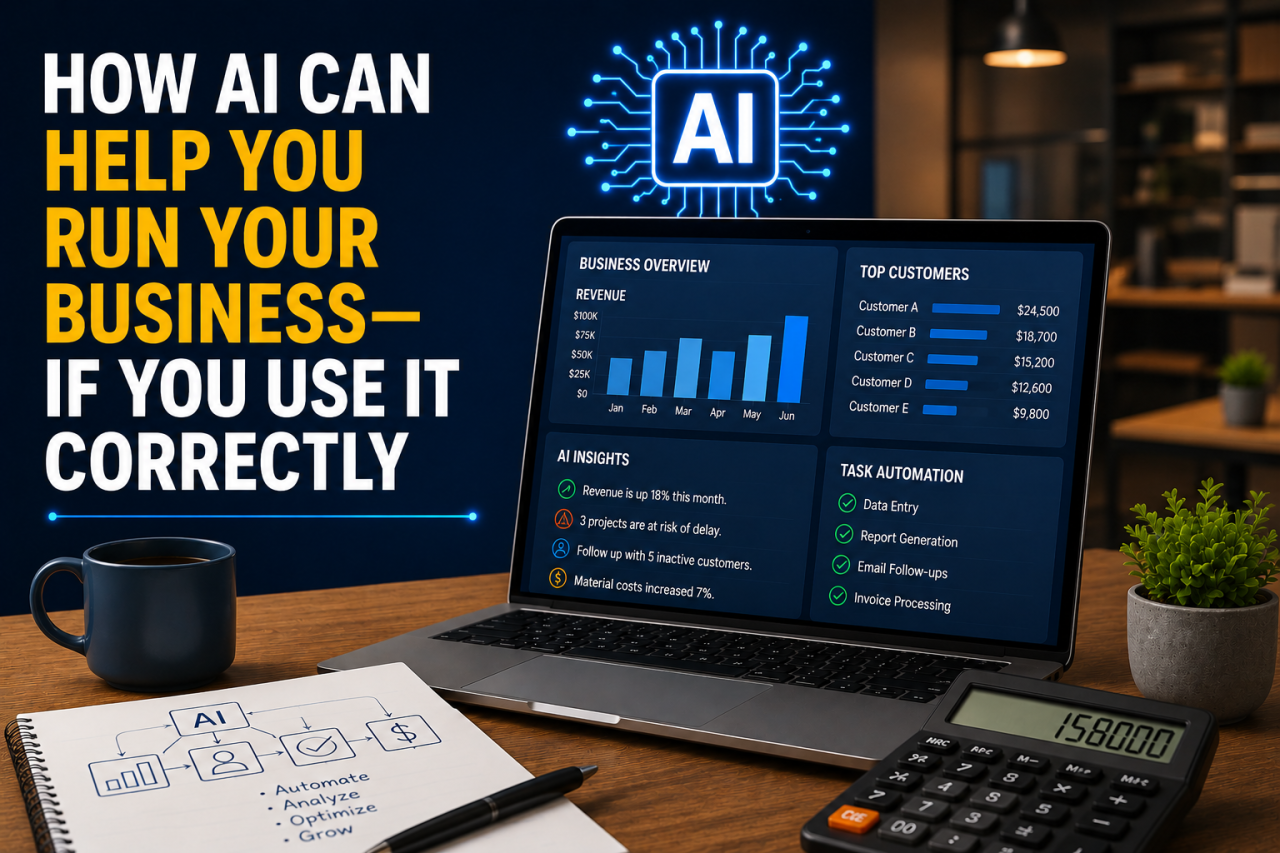
Artificial intelligence is quickly becoming one of the most talked-about technologies in business. From generating emails and analyzing data to answering customer questions and helping employees make decisions, AI seems capable of doing almost anything.
That excitement has also created unrealistic expectations.
AI is not a magic button that automatically makes a company more productive or profitable. Simply giving employees access to an AI tool does not fix inefficient processes, eliminate bad data, or replace the experience required to make good business decisions.
Used incorrectly, AI can actually create additional problems. Employees can receive inaccurate information, customers can get inappropriate responses, sensitive company information can be exposed, and managers can make decisions based on AI-generated conclusions that were never properly verified.
Used correctly, however, AI can become an extremely valuable business tool.
The difference comes down to understanding where AI fits within your organization—and where it doesn’t.
AI Should Assist Your Business, Not Run It
One of the biggest misconceptions surrounding artificial intelligence is that businesses should eventually allow AI to operate everything automatically.
For most companies, that shouldn’t be the goal.
AI works best as an assistant to employees and managers. It can gather information, identify patterns, summarize data, create drafts, automate repetitive tasks, and help people reach decisions faster.
But people should still remain responsible for important decisions.
Think of AI as an extremely fast employee who can process enormous amounts of information but occasionally misunderstands instructions or confidently gives you the wrong answer.
You wouldn’t allow a new employee to approve a $100,000 purchase, send contracts to customers, change your pricing strategy, or make major financial decisions without supervision.
AI should be treated with similar caution.
Companies that benefit the most from artificial intelligence will likely be those that combine AI’s speed with human experience and judgment.
Start With Business Problems, Not AI Features
A common mistake businesses make with new technology is starting with the technology instead of the problem.
Someone sees an impressive AI demonstration and immediately asks:
“How can we use this in our company?”
A better question is:
“What problems in our company could AI help us solve?”
The difference is important.
Look at the areas where your employees spend unnecessary amounts of time.
Where are people manually entering information?
Where are managers struggling to find answers?
Where do employees repeatedly perform the same administrative tasks?
Where does important information become difficult to find?
Where are opportunities being missed because nobody has time to analyze the data?
Those are potential opportunities for AI.
Instead of adopting AI simply because it is popular, businesses should identify specific problems where AI can create measurable improvements.
AI Can Reduce Administrative Work
Every organization has repetitive administrative tasks.
Employees write emails, summarize meetings, prepare documents, enter notes, research information, organize data, and perform dozens of other small activities throughout the day.
Individually, these tasks may only take a few minutes.
Collectively, they can consume hundreds or thousands of employee hours every year.
AI can help reduce that workload.
For example, an employee might use AI to turn rough notes into a professional customer email. A manager could use AI to summarize a lengthy internal report. Salespeople could create first drafts of follow-up messages. Marketing teams could brainstorm campaign ideas or organize content.
The objective isn’t necessarily to eliminate the employee from the process.
Instead, AI creates the first draft.
The employee reviews it, corrects it, adds context, and approves the final result.
Saving five or ten minutes may not sound significant, but multiply those savings across dozens of employees and hundreds of tasks.
Small productivity improvements can become substantial over time.
AI Can Help You Understand Your Business Data
One of the most promising uses of artificial intelligence is helping businesses understand information they already have.
Many companies collect enormous amounts of data through their business software.
They have customer histories, sales records, quotes, orders, invoices, purchasing information, production activity, job costs, service records, and other operational data.
The problem isn’t necessarily collecting information.
The problem is understanding it.
Managers frequently don’t have enough time to analyze thousands of transactions looking for patterns.
AI can potentially make that process easier.
Imagine being able to ask questions such as:
- Which customers have become less active during the past six months?
- Which types of jobs consistently exceed estimated labor hours?
- Which products generate the highest gross margins?
- Which customers request the most quotes but place the fewest orders?
- Which expenses have increased significantly compared with last year?
- Which sales opportunities haven’t received follow-up recently?
Traditional reports can answer many of these questions, but AI may make interacting with business information more intuitive.
Instead of searching through multiple reports, managers may increasingly be able to ask questions using everyday language.
That can make valuable business intelligence accessible to more people within the organization.
AI Can Help Sales Teams Work More Efficiently
Salespeople spend surprisingly large amounts of time doing things other than selling.
They research prospects, update CRM records, write follow-up emails, prepare proposals, review customer histories, and search through previous conversations.
AI can help reduce some of that administrative burden.
For example, before contacting a customer, AI could potentially summarize recent activity:
- Last purchase
- Open quotes
- Previous conversations
- Outstanding issues
- Recent opportunities
- Customer preferences
Instead of spending fifteen minutes researching the account, the salesperson could receive a quick overview.
AI could also help identify opportunities that might otherwise be overlooked.
A system could detect customers who haven’t purchased recently, quotes that haven’t received follow-up, or accounts whose buying patterns have changed.
That doesn’t replace the salesperson.
It gives the salesperson better information.
The relationship, negotiation, judgment, and communication still belong to the human being.
AI Can Improve Customer Service
Customer service is another area where artificial intelligence can be useful—when implemented carefully.
Customers frequently ask repetitive questions.
What’s the status of my order?
When will my project be completed?
Can you resend my invoice?
Do you offer a particular service?
Where can I find certain information?
AI can help employees locate answers faster or potentially handle simple requests automatically.
But businesses need to be cautious about allowing AI to communicate with customers without appropriate safeguards.
A chatbot that gives incorrect pricing information or makes promises the company can’t keep can quickly create problems.
For that reason, AI customer service systems should have clearly defined boundaries.
AI can handle predictable questions.
People should handle complicated situations.
The best customer experience may not be AI versus humans.
It may be AI helping humans respond faster and more accurately.
AI Can Help Managers Spot Problems Earlier
Managers often learn about operational problems after those problems have already become expensive.
A project exceeds its budget.
Production falls behind schedule.
A customer’s purchasing activity declines.
Inventory costs increase.
Profit margins begin shrinking.
AI may help businesses identify these patterns earlier.
For example, AI could analyze historical job performance and identify projects that appear likely to exceed estimated labor.
It could highlight unusual changes in purchasing costs.
It could identify declining customer activity.
It could flag unusual margin differences between similar jobs.
The value isn’t that AI automatically solves these problems.
The value is that management receives an earlier warning.
The earlier you recognize a problem, the more options you usually have to correct it.
AI Is Only as Good as the Information It Receives
This is one of the most important concepts businesses need to understand about artificial intelligence.
Bad data produces bad AI results.
If employees don’t enter accurate information into your business systems, AI cannot magically fix the problem.
Suppose your company wants AI to analyze job profitability.
If employees aren’t recording labor accurately, material costs are missing, purchasing information isn’t connected to jobs, or estimates aren’t properly documented, the analysis may be misleading.
AI might produce an impressive-looking answer.
That doesn’t mean the answer is correct.
Before businesses attempt sophisticated AI projects, they should evaluate the quality of their underlying data.
Are employees consistently using the system?
Are records complete?
Are processes standardized?
Is important information stored in one system or scattered across spreadsheets, emails, and personal notes?
AI becomes significantly more valuable when it has reliable information to work with.
Don’t Put Sensitive Information Into Random AI Tools
Businesses should also think seriously about data security.
Employees may be tempted to copy information into public AI tools because it’s convenient.
That information could include customer lists, pricing information, contracts, employee information, financial records, proprietary processes, passwords, or confidential documents.
Companies should establish clear policies explaining what information employees can and cannot provide to AI systems.
Employees need to understand that an AI tool should be treated like any other third-party technology service.
Before sensitive information is shared, the company should understand how the provider handles that information.
Convenience shouldn’t override security.
AI Can Be Confidently Wrong
Another important limitation of artificial intelligence is that AI-generated answers can sound extremely convincing even when they’re incorrect.
This is particularly dangerous in business.
An employee may receive a detailed answer and assume it must be accurate because it sounds professional.
But AI can misunderstand information, overlook important context, perform faulty reasoning, or generate information that doesn’t exist.
That’s why employees need to verify important AI-generated results.
The greater the consequences of the decision, the greater the level of human review should be.
Using AI to brainstorm ten marketing headlines carries relatively little risk.
Using AI to interpret a contract, calculate tax obligations, make hiring decisions, or approve a major financial transaction carries considerably more.
Businesses need different levels of oversight depending on the situation.
Give AI Context
The quality of an AI response often depends heavily on the quality of the instructions.
Consider the difference between asking:
“Write a sales email.”
and providing:
“Write a short follow-up email to an existing customer who received a quote seven days ago. The goal is to ask whether they have questions without sounding aggressive. Keep the email under 120 words and don’t offer a discount.”
The second request gives the AI significantly more context.
Employees who learn how to communicate effectively with AI tools will generally receive better results.
Useful instructions may include:
- The objective
- Relevant background
- The intended audience
- Important restrictions
- Desired tone
- Required format
- Examples of successful results
Companies adopting AI should therefore invest some time in teaching employees how to use it.
Giving everyone access to AI without training is unlikely to produce the best results.
Create Repeatable AI Processes
Once employees discover useful AI applications, companies should turn successful experiments into repeatable processes.
Suppose a sales manager develops an effective AI prompt for analyzing inactive customers.
Instead of every salesperson creating their own version, the company could develop a standardized process.
The same approach can be applied to customer communication, meeting summaries, job analysis, marketing content, research, and internal documentation.
Standardization creates several advantages.
Results become more consistent.
Employees spend less time experimenting.
Management can review how AI is being used.
New employees can learn successful workflows faster.
AI gradually becomes part of the company’s operating system rather than a collection of random tools employees occasionally use.
Measure Whether AI Is Actually Helping
Businesses should also measure the results of their AI initiatives.
Technology can feel productive without actually producing measurable improvements.
Ask questions such as:
How much employee time is being saved?
Are customers receiving faster responses?
Are salespeople following up more consistently?
Are managers identifying problems earlier?
Has reporting become easier?
Are employees making fewer administrative errors?
Has the company reduced repetitive manual work?
If an AI process doesn’t produce measurable value, reconsider it.
The objective isn’t to use the most AI.
The objective is to run a better business.
Your Business Software Matters More in an AI-Driven World
As artificial intelligence becomes more integrated into business operations, the systems companies use to manage their information will become increasingly important.
A company operating from disconnected spreadsheets, separate applications, employee inboxes, and handwritten notes may struggle to take full advantage of AI.
There simply isn’t one reliable source of information.
Integrated business management software creates a stronger foundation.
When CRM, estimating, orders, purchasing, production, job costing, invoicing, and customer information are connected, businesses have a much clearer picture of what’s happening.
That structured information can make reporting and future AI capabilities significantly more useful.
This is particularly important for industries where every job can be different.
Sign companies, manufacturers, service organizations, and project-based businesses generate enormous amounts of operational information. Understanding that information can reveal opportunities to improve margins, scheduling, purchasing, sales performance, and customer relationships.
AI can help uncover those insights—but only when the underlying information is available.
AI Won’t Fix a Broken Process
There is another reality businesses should keep in mind.
Automating a bad process doesn’t necessarily make it better.
Sometimes it simply makes the bad process happen faster.
Before applying AI, examine the workflow itself.
Why does this task exist?
Does this information need to be entered?
Could the process be simplified?
Should two systems be connected?
Is someone duplicating work unnecessarily?
Sometimes the best solution isn’t artificial intelligence.
It may be eliminating an unnecessary step or improving the company’s business software.
AI should improve good processes rather than disguise broken ones.
Start Small and Learn
Companies don’t need an enormous AI strategy before they begin experimenting.
Start with small, low-risk opportunities.
Choose tasks that are repetitive, time-consuming, and easy for a person to review.
For example:
Drafting routine emails.
Summarizing internal documents.
Organizing meeting notes.
Brainstorming marketing ideas.
Analyzing non-sensitive business information.
Creating first drafts of internal procedures.
Then evaluate the results.
If the process saves time and maintains quality, expand it.
If it creates more work than it saves, change the process.
This approach allows companies to develop practical AI experience without unnecessarily exposing the organization to risk.
The Competitive Advantage Isn’t AI—It’s How You Use It
Eventually, artificial intelligence will probably become a standard feature of everyday business software.
Having access to AI won’t necessarily provide a competitive advantage because nearly everyone will have access to similar technology.
The advantage will come from how companies use it.
Businesses with organized processes, accurate data, integrated systems, knowledgeable employees, and clear AI policies will be positioned to get more value from these tools.
Businesses with disconnected systems, unreliable information, and inconsistent processes may discover that AI simply exposes the problems they already had.
Technology amplifies what already exists.
A well-run company can use AI to become more efficient.
A poorly organized company may simply create confusion faster.
Use AI to Make Better Decisions, Not Avoid Them
Artificial intelligence represents an important opportunity for businesses.
It can reduce administrative work, help employees find information faster, uncover patterns in business data, improve customer service, support sales teams, and give managers better visibility into their operations.
But AI should not become a substitute for judgment.
Business owners still need to understand their customers.
Managers still need to manage.
Salespeople still need to build relationships.
Employees still need to verify important information.
And companies still need reliable systems and processes.
The businesses that succeed with AI won’t necessarily be the companies that automate everything.
They’ll be the companies that understand where automation helps—and where human experience still matters.
At Mothernode, we believe technology should make businesses easier to manage by connecting the information teams need across CRM, sales, operations, purchasing, production, job costing, and other critical workflows. As AI continues to evolve, having organized, accessible business data will become even more valuable.
AI can help you run your business.
Just don’t expect it to run your business for you.