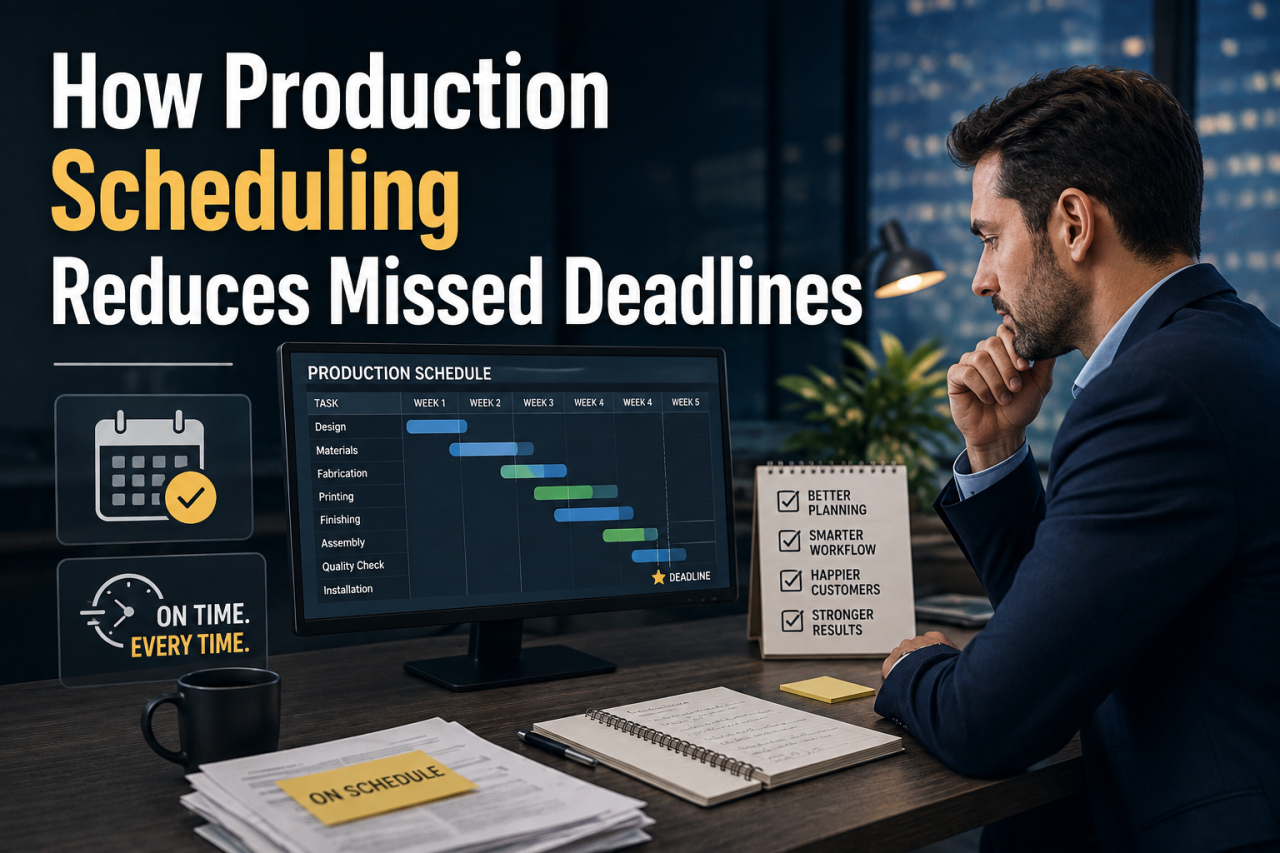
For a sign company, few things damage customer relationships faster than a missed deadline.
Customers often plan installations around grand openings, construction schedules, marketing campaigns, trade shows, tenant move-ins, and other events that cannot easily be moved. When a sign is supposed to be ready on Friday, delivering it the following Tuesday may create problems far beyond the production floor.
Yet missed deadlines are not always caused by employees working too slowly or vendors delivering materials late. In many cases, the underlying problem is much simpler: the company does not have a reliable production scheduling process.
As sign companies grow, managing production becomes increasingly complicated. Multiple jobs move through design, permitting, purchasing, fabrication, printing, finishing, assembly, electrical work, quality control, and installation. Every department has its own workload, and many jobs depend on work being completed elsewhere before they can move forward.
Without a centralized production schedule, teams can quickly lose visibility into what needs to happen next.
Production scheduling gives sign companies a structured way to organize work, prioritize jobs, allocate resources, and identify potential delays before they become missed deadlines.
Here is how better production scheduling can help sign companies deliver projects more consistently and operate more efficiently.
Why Sign Company Production Is Difficult to Schedule
Sign manufacturing is different from many traditional manufacturing environments.
A company producing thousands of identical products can build a predictable production process around the same materials, machines, and workflows.
Sign companies often operate differently.
One customer may order channel letters. Another needs monument signage. Another may need a vehicle wrap, while another project involves interior ADA signs, digital displays, or a complete building signage package.
Each job may require a different combination of:
- Design work
- Engineering
- Permitting
- Material purchasing
- Printing
- CNC routing
- Welding
- Painting
- Electrical assembly
- Vinyl production
- Finishing
- Quality control
- Shipping
- Installation
The complexity increases when several projects are moving through production simultaneously.
A delay in one department can affect several others.
For example, fabrication cannot begin if materials have not arrived. Installation cannot be scheduled if production is incomplete. Production may not begin if artwork has not been approved.
This creates a chain of dependencies.
Production scheduling helps companies manage those dependencies instead of relying on employees to remember them.
What Is Production Scheduling?
Production scheduling is the process of determining what work needs to be completed, when it should be completed, and which resources are responsible for completing it.
A production schedule typically considers several factors:
- Customer deadlines
- Job priority
- Production capacity
- Employee availability
- Machine availability
- Material availability
- Vendor lead times
- Department workloads
- Installation dates
Instead of treating every job as a single project with one final due date, scheduling breaks the job into smaller production stages.
For example, a sign project due on August 30 might have internal deadlines such as:
Design approval — August 8
Materials ordered — August 9
Materials received — August 14
Fabrication completed — August 20
Paint completed — August 23
Assembly completed — August 26
Quality control — August 27
Installation — August 30
These internal deadlines give teams something far more useful than simply knowing the customer expects the sign by August 30.
Everyone can see when their portion of the project needs to be completed.
Production Scheduling Creates Clear Priorities
One of the biggest challenges in a busy sign shop is deciding which job should be worked on next.
When priorities are unclear, employees often make that decision themselves.
They may work on the easiest job, the newest job, the project someone recently asked about, or whichever work order happens to be sitting closest to them.
Meanwhile, a high-priority project may quietly approach its deadline.
A production schedule establishes clear priorities based on actual project requirements.
Employees can see which jobs are due first and which production steps must be completed to keep those projects on schedule.
Instead of repeatedly asking managers what to work on next, employees can rely on the production schedule.
That reduces confusion while helping managers keep critical projects moving.
Scheduling Makes Workload Problems Visible
A deadline may look completely reasonable when a salesperson enters an order.
The problem is that the production department may already have more work scheduled than it can realistically complete.
Imagine a fabrication department capable of completing approximately 200 production hours during a particular week.
If 310 hours of fabrication work are scheduled for that same period, something is going to happen.
Employees may need overtime.
Projects may need to be moved.
Work may need to be outsourced.
Or deadlines may be missed.
Without production scheduling, management may not recognize the problem until jobs are already late.
A good scheduling process helps expose capacity problems earlier.
Managers can compare incoming demand against available production resources and make adjustments before promising unrealistic delivery dates.
Better Scheduling Connects Sales and Production
Sales and production sometimes operate with very different perspectives.
Salespeople want to satisfy customers and close deals. Production teams need enough time to actually manufacture what was sold.
Problems occur when customers are promised deadlines without considering the shop’s existing workload.
A centralized production scheduling system can help connect these departments.
Before committing to an aggressive delivery date, sales teams can have better visibility into current production capacity.
If the shop is already heavily booked, the salesperson may provide a more realistic delivery date instead of making a promise production cannot keep.
That improves communication internally and sets better expectations with customers.
Scheduling Helps Identify Bottlenecks
Most production environments have bottlenecks.
A bottleneck occurs when one process has less capacity than the processes around it.
For example, a sign company might have plenty of printing capacity but limited finishing capacity. Or fabrication may move quickly while painting consistently becomes backed up.
These bottlenecks are not always obvious when jobs are managed individually.
Production scheduling allows managers to see workloads across departments.
Patterns begin to emerge.
Maybe projects regularly wait three days for paint.
Maybe electrical assembly becomes overloaded every Thursday.
Maybe installation crews are consistently scheduled beyond their realistic capacity.
Once managers identify these patterns, they can begin addressing them.
Solutions might include:
- Cross-training employees
- Adding equipment
- Adjusting staffing
- Changing shift schedules
- Outsourcing certain processes
- Improving purchasing
- Rescheduling work earlier
The goal is not simply to make employees work faster. It is to create a production flow that reflects the actual capacity of the business.
Scheduling Creates Earlier Warning Signs
Without production scheduling, companies often discover a problem only after a deadline has already been missed.
With scheduling, problems become visible earlier.
Suppose a sign is scheduled for installation Friday.
According to the production schedule, fabrication should have been completed Monday.
If fabrication is still incomplete Tuesday afternoon, management immediately knows the project is falling behind.
There may still be time to respond.
The company might shift resources, authorize overtime, adjust another project, expedite materials, or move the installation crew.
Early warning is extremely valuable.
A problem discovered four days before a deadline may be manageable.
The same problem discovered four hours before installation probably is not.
Material Purchasing Becomes More Predictable
Production scheduling and purchasing are closely connected.
Employees cannot manufacture products without the necessary materials.
Unfortunately, purchasing is sometimes handled reactively.
A production employee starts working on a project and suddenly discovers that a required material is unavailable.
Now purchasing needs to find the material immediately, potentially pay expedited shipping, or delay the project.
Production scheduling provides purchasing teams with greater visibility into upcoming demand.
If fabrication is scheduled to begin next Wednesday, purchasing knows materials must arrive before then.
That makes it easier to account for vendor lead times and avoid last-minute purchases.
It can also reduce unnecessary expedited freight costs.
Scheduling Improves Coordination Between Departments
A sign project rarely belongs to only one department.
It moves through the organization.
Design hands work to production. Production hands completed products to installation. Purchasing supports production. Project managers coordinate customers, permits, approvals, and vendors.
If these departments operate independently, information can become fragmented.
One department may believe a job is ready while another is still waiting for something.
Production scheduling creates a shared timeline.
Everyone can see where the job should be and what must happen next.
That improves coordination and reduces the amount of time employees spend chasing status updates.
Instead of asking:
“Has fabrication finished this?”
“Did those materials arrive?”
“Is this ready for paint?”
“When is installation?”
Employees can reference a centralized system that shows the current status and scheduled dates.
Scheduling Helps Prevent Rush Jobs
Every sign company occasionally receives a legitimate rush project.
The bigger problem is when normal projects become rush projects because they were not managed properly.
A project may sit untouched for days or weeks. Then someone notices the customer deadline approaching.
Suddenly everything becomes urgent.
Employees are pulled away from other projects. Managers begin expediting materials. Overtime increases. Existing schedules are disrupted.
One late project can create several additional late projects.
Production scheduling helps prevent this domino effect.
By assigning internal deadlines throughout the project, work begins at the appropriate time instead of waiting until the final deadline becomes urgent.
Better Scheduling Can Reduce Overtime
Overtime is sometimes necessary, particularly during busy periods.
But excessive overtime may indicate poor planning.
If managers cannot see future production demand, staffing decisions become reactive.
Employees may work normal hours early in the week and then be asked to work late because several projects suddenly need to ship.
Scheduling provides greater visibility into upcoming workloads.
Managers can see busy periods earlier and adjust accordingly.
They might:
- Shift employees between departments
- Approve overtime earlier
- Hire temporary help
- Outsource certain work
- Move lower-priority jobs
- Adjust installation schedules
Better planning can make overtime more strategic instead of something required to recover from scheduling problems.
Production Scheduling Improves Customer Communication
Customers understand that complicated projects sometimes experience delays.
What frustrates customers is uncertainty.
When a customer asks for an update and the company cannot provide a clear answer, confidence begins to decline.
A structured production schedule gives salespeople and project managers better information.
Instead of saying:
“I think production is working on it.”
They may be able to say:
“Your project is currently in fabrication. Painting is scheduled for Thursday, final assembly is Monday, and installation remains scheduled for next Wednesday.”
That level of visibility creates a much better customer experience.
And if a delay does occur, the company can communicate it earlier rather than surprising the customer on the delivery date.
Digital Scheduling Is More Effective Than Whiteboards
Many production shops begin with simple scheduling tools.
A whiteboard may work when the company has a handful of active projects.
As the company grows, however, manual scheduling becomes difficult to maintain.
Whiteboards have several limitations.
They may not automatically update when deadlines change. Employees outside the production area cannot easily see them. Historical information is difficult to track. Jobs can be erased or overlooked.
Spreadsheets improve accessibility but introduce other problems.
Multiple versions may exist. Employees may forget to update them. Information may need to be entered in several systems.
Modern business management and ERP software can create a more connected scheduling process.
Production schedules can be linked directly to jobs, customers, work orders, purchasing, inventory, and installation activities.
That reduces duplicate data entry and gives departments access to the same information.
Scheduling Works Best When Connected to the Entire Business
Production scheduling becomes even more powerful when it is part of an integrated business management platform.
Consider what happens when different systems are connected.
A salesperson creates a quote.
The customer approves it.
The quote becomes an order.
The project generates production requirements.
Materials can be purchased.
Production tasks can be scheduled.
Employees record labor and material usage.
Completed work moves to installation.
Job costing compares estimated costs against actual costs.
Management can then evaluate whether the project was profitable.
Instead of operating as separate processes, the entire workflow becomes connected.
Platforms such as Mothernode ERP are designed to help companies centralize processes including CRM, estimating, order management, purchasing, inventory, production, scheduling, and job costing.
For sign companies managing increasingly complex projects, this type of visibility can make production easier to control.
Production Data Can Improve Future Estimates
Production scheduling is not only about today’s projects.
It can also generate valuable information for future planning.
Suppose a company estimates that a certain type of illuminated sign normally requires 18 fabrication hours.
After tracking multiple projects, the company discovers the average is actually 27 hours.
That information affects more than scheduling.
It can improve estimating and job costing.
Future quotes can include more realistic labor requirements, and production schedules can allocate appropriate capacity.
Over time, companies can develop increasingly accurate expectations about how long different types of work actually take.
How to Start Improving Production Scheduling
Sign companies do not need to redesign their entire production operation overnight.
Start by documenting the stages that most jobs move through.
For example:
Sales
Design
Customer approval
Permitting
Purchasing
Fabrication
Printing
Finishing
Assembly
Quality control
Installation
Then determine which stages require internal deadlines.
Next, identify available capacity within each department.
How many realistic production hours are available each week?
Which machines or employees represent limited resources?
Finally, begin comparing scheduled demand against available capacity.
Even this basic process can reveal why certain projects consistently fall behind.
As the business grows, software can help automate and centralize much of this information.
Measure Scheduling Performance
A production schedule should not simply exist. Management should evaluate whether it is working.
Useful metrics may include:
- Percentage of jobs completed on time
- Average days late
- Production hours scheduled versus available
- Estimated versus actual production hours
- Number of rush jobs
- Overtime hours
- Average production cycle time
- Time spent waiting between departments
- Vendor-related delays
- Installation reschedules
Tracking these numbers can help management determine where improvements are needed.
For example, if production completion rates improve but installations are still frequently late, the problem may be installation capacity rather than manufacturing.
Data helps companies focus on the real problem instead of guessing.
Better Scheduling Creates a More Predictable Business
The biggest benefit of production scheduling is not simply fewer missed deadlines.
It is predictability.
Managers gain better visibility into workloads.
Employees understand their priorities.
Purchasing knows when materials are required.
Sales teams can provide more realistic delivery dates.
Project managers can identify problems earlier.
Customers receive better information.
And leadership gains a clearer understanding of how effectively the company is using its resources.
For growing sign companies, predictability becomes increasingly important.
What worked when the business handled 20 active jobs may not work when it manages 100.
Eventually, memory, spreadsheets, whiteboards, and verbal communication become difficult to scale.
A structured production scheduling process provides the framework needed to manage that growth.
Production Scheduling Turns Deadlines Into a Process
Missed deadlines are rarely caused by one isolated mistake.
They are often the result of many small problems accumulating throughout a project.
Artwork was approved two days late.
Materials were ordered three days late.
Fabrication started behind schedule.
Painting became overloaded.
Installation was booked before production was actually ready.
Each problem may seem minor individually.
Together, they can cause a project to miss its promised delivery date.
Production scheduling turns the deadline from a single date on a calendar into a series of manageable milestones.
Instead of waiting until the end of the project to determine whether the company is on schedule, managers can monitor progress throughout the entire process.
That allows teams to identify delays earlier, prioritize work more effectively, and make better decisions about capacity.
For sign companies looking to improve on-time delivery, production scheduling is not simply another administrative task.
It is an essential part of building a more efficient, scalable, and profitable operation.
With the right processes—and an integrated platform such as Mothernode ERP—sign companies can gain greater control over production, reduce last-minute surprises, and give customers something every business wants to provide:
A reliable delivery date they can actually count on.