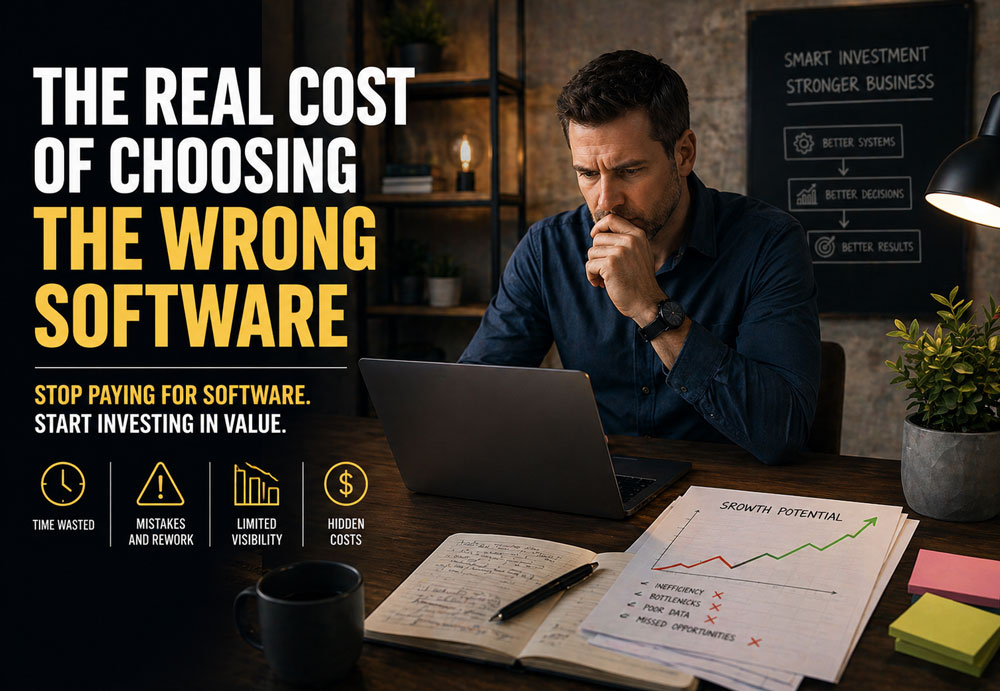
The Real Cost of Choosing the Wrong Software: Why “Cheap” Can Quietly Kill Your Growth
Most companies don’t fail because they made one catastrophic decision. They fail—or more accurately, they stall—because of a series of small, seemingly reasonable decisions that compound over time.
Choosing the wrong software is one of those decisions.
On paper, it often looks smart. Lower monthly cost. Faster onboarding. Fewer perceived risks. But in practice, it creates operational drag, limits visibility, and quietly caps your company’s ability to scale.
This isn’t just an IT decision. It’s a growth decision.
Let’s break it down.
The Illusion of “Saving Money”
At the surface level, software decisions are usually framed around subscription cost:
- “This platform is $300/month.”
- “That one is $1,200/month.”
- “Let’s go with the cheaper option.”
That thinking is flawed.
Why? Because it isolates cost without measuring impact.
The cheaper platform may save you $900/month—but what if it:
- Adds 20 hours of manual work across your team?
- Introduces errors that cost you rework and lost margins?
- Limits visibility into your operations?
- Prevents you from scaling efficiently?
You didn’t save $900.
You spent far more—you just didn’t track it.
The Real Problems That Come With the Wrong Software
1. Operational Inefficiency Becomes the Norm
When software doesn’t fully support your workflow, your team compensates.
That looks like:
- Manual data entry across multiple systems
- Spreadsheet workarounds
- Constant back-and-forth between departments
- Re-entering the same data multiple times
These aren’t one-off issues. They become embedded in your daily operations.
Over time, inefficiency stops being visible. It becomes “how we do things.”
That’s dangerous.
Because now your team isn’t focused on growth—they’re focused on maintaining broken processes.
2. You Replace Old Problems With New Ones
Most companies switch software to solve problems.
But when the wrong system is chosen, you don’t eliminate problems—you reshuffle them.
Instead of:
- Poor communication
You now have:
- Data fragmentation
Instead of:
- Slow estimating
You now have:
- Inaccurate reporting
Instead of:
- Lack of structure
You now have:
- Rigid workflows that don’t match your business
The net result? You’re still stuck—just in a different way.
3. Lack of Visibility = Poor Decision-Making
This is where the real damage happens.
Weak systems don’t give you:
- Real-time reporting
- Accurate forecasting
- Clear job costing
- Operational transparency
So what do you do?
You guess.
You make decisions based on incomplete or outdated information.
And in business, guessing is expensive.
Without visibility:
- You can’t identify bottlenecks early
- You can’t forecast capacity or revenue accurately
- You can’t understand where you’re actually making or losing money
You’re operating blind—and growth doesn’t happen in the dark.
4. Hidden Labor Costs Skyrocket
Here’s a simple truth:
If your software doesn’t do the work, your people will.
And people are far more expensive than software.
Let’s say:
- Your system saves $500/month
- But costs your team 10 extra hours/week
At a conservative $30/hour, that’s:
- $1,200/month in hidden labor costs
You didn’t save money.
You doubled your cost structure—without realizing it.
5. Errors Multiply—and So Do Their Consequences
Manual processes lead to mistakes.
Mistakes lead to:
- Rework
- Missed deadlines
- Customer dissatisfaction
- Margin erosion
And here’s the kicker: errors compound.
A small mistake in estimating can:
- Impact production
- Affect scheduling
- Disrupt installation
- Lead to financial discrepancies
The wrong software doesn’t just allow errors—it amplifies them.
6. Growth Hits a Ceiling
This is the silent killer.
Cheap or limited systems often work “fine” at a small scale.
But as you grow:
- More jobs
- More employees
- More complexity
The cracks widen.
Eventually:
- The system can’t handle volume
- Processes break down
- Teams become overwhelmed
At that point, you’re not scaling—you’re surviving.
And growth slows… or stops entirely.
The Compounding Cost of Switching Later
Here’s where the decision really comes back to bite.
When you outgrow the wrong system, you have to switch.
And switching isn’t cheap.
You Pay Twice
- You continue paying for the old system
- You start paying for the new system
- You may overlap for months
What you avoided upfront, you now pay in duplicate.
You Introduce Operational Chaos
Transitioning systems creates:
- Temporary process breakdowns
- Training gaps
- Data migration challenges
- Workflow inconsistencies
Your team now has to:
- Learn a new system
- Maintain the old one
- Keep operations running
That’s not efficiency. That’s strain.
Implementation Costs Come Back—Bigger
Many companies avoid higher-end platforms because of implementation costs.
But when you switch later:
- You still pay those costs
- Plus the cost of undoing your previous setup
- Plus the cost of lost time and productivity
You didn’t avoid implementation.
You delayed it—and made it more expensive.
The Hidden Cost of Playing It Safe
There’s a mindset behind choosing cheaper software:
“We’ll start here and upgrade later.”
It feels responsible.
It’s not.
Because what you’re really saying is:
“We’re okay limiting our growth for now.”
And growth doesn’t wait.
Opportunities don’t pause while you outgrow your tools.
By the time you realize your system is holding you back:
- Competitors have moved ahead
- Your processes are harder to unwind
- Your team is used to inefficient habits
The cost isn’t just operational.
It’s strategic.
How to Measure the Real Value of Software
If subscription cost isn’t the right metric—what is?
You need to evaluate software based on impact, not price.
Here’s how.
1. Time Saved vs. Time Wasted
Ask:
- How much manual work does this eliminate?
- How many steps does it remove from our processes?
- How much faster can we complete key tasks?
Time is your most valuable resource.
Software should give it back to you.
2. Error Reduction
Look at:
- How often mistakes occur today
- Where they originate
- How the system prevents them
Fewer errors = higher margins.
That’s measurable.
3. Visibility and Control
Can you:
- See real-time performance?
- Identify bottlenecks instantly?
- Track job profitability accurately?
- Forecast future workload and revenue?
If the answer is no, the system is limiting you.
4. Scalability
Ask:
- Will this system support us at 2x, 5x, 10x growth?
- Or will we need to replace it?
If replacement is inevitable, factor that cost in now.
5. Decision-Making Speed
Better systems enable:
- Faster decisions
- More confident decisions
- Proactive decisions
That’s a competitive advantage.
6. Team Efficiency and Morale
This one is overlooked.
Good software:
- Reduces frustration
- Simplifies workflows
- Empowers employees
Bad software:
- Creates friction
- Slows people down
- Leads to burnout
Your team’s performance is directly tied to the tools you give them.
Reframing the Conversation: Cost vs. Value
Here’s the shift companies need to make:
Stop asking: “What does it cost?”
Start asking: “What does it return?”
A $1,500/month platform that:
- Saves 40 hours of labor
- Reduces errors by 50%
- Improves visibility across the business
- Enables better forecasting
…isn’t expensive.
It’s underpriced.
Meanwhile, a $300/month system that:
- Requires constant manual work
- Creates bottlenecks
- Limits growth
…isn’t cheap.
It’s costly.
The Strategic Play: Invest for Where You’re Going
The best companies don’t buy software for where they are today.
They buy for where they’re going.
That means:
- Anticipating growth
- Planning for complexity
- Prioritizing scalability
- Valuing long-term efficiency over short-term savings
Yes, the upfront cost may be higher.
But the long-term return is exponentially greater.
Final Thought: The Numbers Always Flip
When you choose the wrong software:
- The subscription is cheap
- The benefits are minimal
- New problems replace old ones
When you choose the right software:
- The subscription may be higher
- But the value multiplies across your entire operation
The numbers always flip.
The only question is when you’ll feel it:
- Slowly, through inefficiency and lost growth
- Or all at once, when you’re forced to switch
Either way, you pay.
The smarter move?
Invest in software that drives your business forward from day one.
Because in the end, software isn’t a cost center.
It’s a growth engine.
And if it’s not—it’s holding you back.