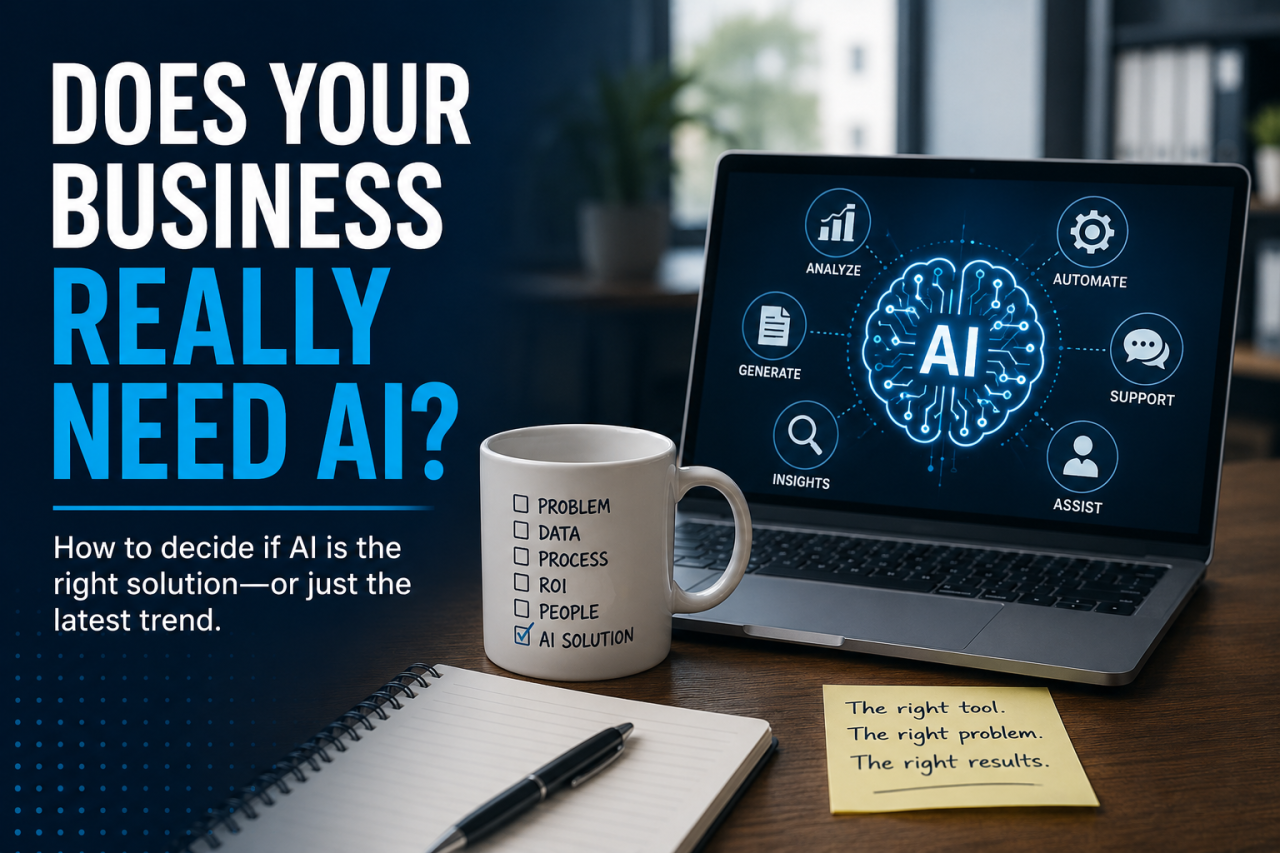
Artificial intelligence has quickly become one of the most talked-about technologies in business. Software companies are adding AI features to their products, employees are experimenting with AI assistants, and business owners are hearing that AI will transform everything from sales and marketing to customer service and operations.
With all that attention, it can start to feel like every company needs an AI strategy immediately.
But does your business really need AI?
The answer isn’t automatically yes.
AI can be an extremely useful business tool, but simply adding artificial intelligence to your organization doesn’t guarantee better results. In some situations, AI can save employees hours of work, uncover information that would otherwise be difficult to find, and help companies operate more efficiently. In other situations, businesses may be trying to solve problems that have very little to do with AI.
Before investing in another piece of technology, businesses should ask a more practical question:
What problem are we trying to solve?
Once you answer that question, it becomes much easier to determine whether AI belongs in the solution.
AI Should Solve a Business Problem
One of the biggest mistakes companies can make with new technology is starting with the technology instead of the problem.
A business owner hears about artificial intelligence and begins looking for ways to implement it.
That’s backward.
Instead, start by identifying areas where your organization struggles.
Maybe your salespeople spend too much time preparing quotes.
Maybe managers have difficulty finding information about customers and projects.
Perhaps employees repeatedly enter the same information into multiple systems.
Maybe your company has years of valuable operational data but very little ability to analyze it.
Those are business problems.
Once you understand them, you can evaluate different solutions. Sometimes AI will be part of the answer. Sometimes automation, better software, improved processes, employee training, or better data management will accomplish the same goal more effectively.
Technology should support the business—not become the objective itself.
Where AI Can Provide Real Business Value
Although businesses shouldn’t adopt AI simply because it’s popular, there are plenty of situations where it can provide meaningful benefits.
The key is finding tasks where AI’s strengths match the needs of the organization.
Repetitive Administrative Work
Many employees spend significant portions of their workday performing small administrative tasks.
Writing routine emails, summarizing information, organizing notes, preparing documents, researching customers, reviewing records, and entering information may only take a few minutes individually.
Together, however, those minutes can become hours every week.
AI can help employees complete some of these activities more quickly.
For example, an employee might use an AI assistant to summarize a long document before reviewing it in detail. A salesperson might generate a first draft of a follow-up email based on information from a customer conversation.
The employee still reviews and approves the final result, but AI helps eliminate some of the initial work.
Multiply those small productivity improvements across an entire organization and the impact can become substantial.
Finding Information Faster
Businesses accumulate enormous amounts of information.
Customer records. Emails. Quotes. Orders. Project notes. Service histories. Purchase orders. Financial information. Product documentation.
The problem isn’t always collecting information.
It’s finding the right information when someone needs it.
Traditional business software usually requires employees to know exactly where to look. AI can potentially create a more conversational way of interacting with business information.
Instead of navigating through several reports, a manager might eventually ask:
“Which customers haven’t purchased from us in the last six months?”
Or:
“Which projects exceeded their estimated labor hours last quarter?”
Or:
“Show me customers with open quotes worth more than $25,000.”
When AI is properly connected to reliable business data, these types of questions can help employees access useful information faster.
That can be far more valuable than simply using AI to generate text.
Analyzing Business Data
Your company may already have one of the most valuable ingredients required for effective AI: data.
Every transaction creates information.
Sales activity reveals what customers are buying.
Quotes reveal opportunities that were won or lost.
Job costing reveals where projects are profitable.
Inventory activity reveals which products move quickly.
Service records reveal recurring customer problems.
Employee activity can reveal bottlenecks in operational processes.
The challenge is turning that information into something useful.
AI can help businesses identify patterns that may be difficult to notice manually.
A company could potentially use AI-assisted analysis to identify customers whose purchasing activity is declining, products with shrinking margins, jobs that regularly exceed estimated costs, or sales opportunities that require attention.
The objective isn’t to have AI make every decision.
The objective is to give people better information when making those decisions.
AI Can Help Employees—Without Replacing Them
Much of the discussion surrounding artificial intelligence focuses on replacing jobs.
For many businesses, however, the more immediate opportunity is improving employee productivity.
Consider a salesperson who spends part of the day communicating with prospects and another part entering information, researching accounts, preparing proposals, updating records, and organizing follow-ups.
If AI reduces some of the administrative workload, that salesperson can spend more time actually selling.
The same idea applies throughout an organization.
Managers can spend less time assembling reports and more time addressing operational problems.
Customer service representatives can locate account information faster.
Project managers can identify potential delays earlier.
Executives can analyze business performance without waiting for someone to manually create another spreadsheet.
In these situations, AI isn’t replacing the employee.
It’s increasing the amount of productive work the employee can accomplish.
When Your Business Probably Doesn’t Need AI
AI isn’t the answer to every operational problem.
Sometimes companies become interested in artificial intelligence when the real problem is much simpler.
Imagine a business where employees constantly enter incorrect customer information.
An AI system probably isn’t the first solution.
The company may simply need standardized procedures, required fields, validation rules, or employee training.
Or imagine a business that can’t accurately determine whether projects are profitable.
Before implementing an advanced AI analytics system, the company should make sure it is consistently tracking labor, materials, purchasing, and project costs.
AI can’t analyze information that doesn’t exist.
In many cases, businesses need to improve their operational foundation before adding artificial intelligence.
Bad Data Creates Bad AI
One of the most important realities businesses need to understand about AI is that its usefulness often depends on the quality of the information available to it.
If your business data is incomplete, duplicated, outdated, or inaccurate, AI may simply help you analyze bad information faster.
Suppose a company wants AI to identify its most profitable customers.
That sounds straightforward.
But what happens if project costs aren’t being tracked correctly?
What if labor hours are missing?
What if purchasing information isn’t connected to the project?
What if duplicate customer records exist?
The AI might produce an answer, but that doesn’t mean the answer is reliable.
Before businesses become overly focused on artificial intelligence, they should pay attention to something much less exciting:
Data quality.
Clean, organized, accessible business information is what makes advanced technology useful.
Your Processes Matter Too
Technology works best when the underlying business process makes sense.
If your quoting process is inconsistent, adding AI probably won’t magically fix it.
If salespeople don’t follow up with opportunities, AI-generated sales reports won’t solve the problem by themselves.
If project managers don’t update job information, AI won’t have reliable information to analyze.
This is why implementing AI should often begin with process evaluation.
Ask questions such as:
Where are employees losing time?
Where are mistakes happening?
Which activities are repetitive?
Where does information become difficult to find?
Which decisions would benefit from better information?
Once you understand those areas, you can determine where AI might actually improve the process.
Start Small Instead of Trying to Transform Everything
Businesses don’t need to launch a massive AI initiative to start seeing benefits.
In fact, starting small is often the better approach.
Choose one clearly defined problem.
For example:
Your sales team spends too much time writing follow-up emails.
Your managers spend hours creating weekly summaries.
Your employees struggle to find information buried in customer records.
Your estimating department wants to compare estimated costs with actual job costs more efficiently.
Then test whether AI can improve that specific process.
Measure the results.
Did employees save time?
Did accuracy improve?
Did customers receive faster responses?
Did managers get better information?
Did the company make better decisions?
If the answer is yes, expand from there.
This approach makes AI implementation much easier to evaluate because you’re measuring business outcomes instead of simply measuring how much AI you’re using.
Don’t Ignore Security and Privacy
Before employees begin putting business information into AI tools, companies need clear policies about what information can and cannot be shared.
Customer information, employee records, contracts, pricing, financial information, intellectual property, and other sensitive data shouldn’t automatically be entered into public AI services.
Businesses need to understand how their AI providers handle data.
Important questions include:
How is information stored?
Is customer data used to train AI models?
Who can access the information?
How long is information retained?
What security controls are available?
Can administrators control employee access?
AI adoption should be treated like any other technology decision involving important business data.
Convenience should never eliminate basic security practices.
AI Still Needs Human Oversight
Artificial intelligence can produce remarkably convincing answers.
Unfortunately, convincing doesn’t always mean correct.
AI systems can misunderstand questions, overlook important context, make incorrect assumptions, or generate inaccurate information.
That means employees need to review AI-generated work.
A salesperson shouldn’t automatically send an AI-generated proposal without checking the pricing, commitments, and details.
A manager shouldn’t make a major financial decision based entirely on an AI-generated analysis.
An employee shouldn’t assume an AI-generated customer response accurately reflects company policy.
AI works best when it assists human judgment rather than replacing it.
Think of AI as another business tool.
A spreadsheet doesn’t make financial decisions for your company.
A CRM doesn’t decide which customers deserve your attention.
An ERP system doesn’t run your business by itself.
These systems organize information so people can make better decisions.
AI should be approached the same way.
Ask Whether the ROI Makes Sense
Not every productivity improvement justifies an investment.
Before implementing AI technology, businesses should consider the potential return.
Suppose an AI tool costs your company $1,000 per month.
If it saves employees 100 hours of administrative work each month, that investment may be easy to justify.
But if employees rarely use it and it saves only a few hours, the economics may look very different.
Consider both direct and indirect benefits.
AI might reduce administrative labor.
It might help salespeople respond to opportunities faster.
It might improve customer service.
It could identify costly operational problems earlier.
It might help managers make decisions faster.
The important thing is connecting the technology to measurable business outcomes.
“We use AI” isn’t a business result.
“We reduced the average time required to prepare a proposal by 40 percent” is.
Five Questions to Ask Before Investing in AI
Before implementing an AI solution, business owners and managers should answer five basic questions.
1. What problem are we trying to solve?
If you can’t clearly define the problem, you’re probably not ready to select the technology.
2. Do we have the data required?
AI needs accurate and accessible information to produce useful insights.
3. Can existing software or automation solve the problem?
Sometimes a workflow improvement is simpler, cheaper, and more reliable than AI.
4. How will we measure success?
Define the expected result before implementation.
5. Who will review the AI’s work?
Human oversight should be built into important business processes.
These questions help separate meaningful AI opportunities from technology experiments that may never produce measurable value.
The Businesses That Benefit Most From AI Will Use It Carefully
The companies that gain the greatest advantage from artificial intelligence probably won’t be the businesses that use AI everywhere.
They’ll be the businesses that use it strategically.
They’ll understand their processes.
They’ll maintain accurate business data.
They’ll identify repetitive work.
They’ll look for opportunities where employees need better information.
And they’ll measure whether AI actually improves the business.
That distinction matters.
AI isn’t a business strategy by itself.
It’s a tool that can support a business strategy.
So, Does Your Business Really Need AI?
Maybe.
Your business doesn’t need AI simply because competitors are talking about it. You don’t need it because it’s appearing in every software product, and you certainly don’t need to implement artificial intelligence just so your company can say it is “AI-powered.”
What your business needs are efficient processes, reliable information, productive employees, strong customer relationships, and the ability to make good decisions.
If AI helps you accomplish those things faster or more effectively, then it may be worth adopting.
If it doesn’t, there may be better places to invest your time and money.
The smartest approach to artificial intelligence isn’t asking:
“How can we use more AI?”
It’s asking:
“Where can AI create measurable value for our business?”
That’s the question that separates useful technology from expensive distractions.
At Mothernode, we believe business technology should make work easier, information more accessible, and decisions more informed. Whether you’re exploring AI, automation, CRM, ERP, job costing, sales management, or other business systems, the goal should remain the same: use technology to solve real problems and help your organization operate more effectively.
Because ultimately, the question isn’t whether your business needs AI.
It’s whether AI can help you build a better business.