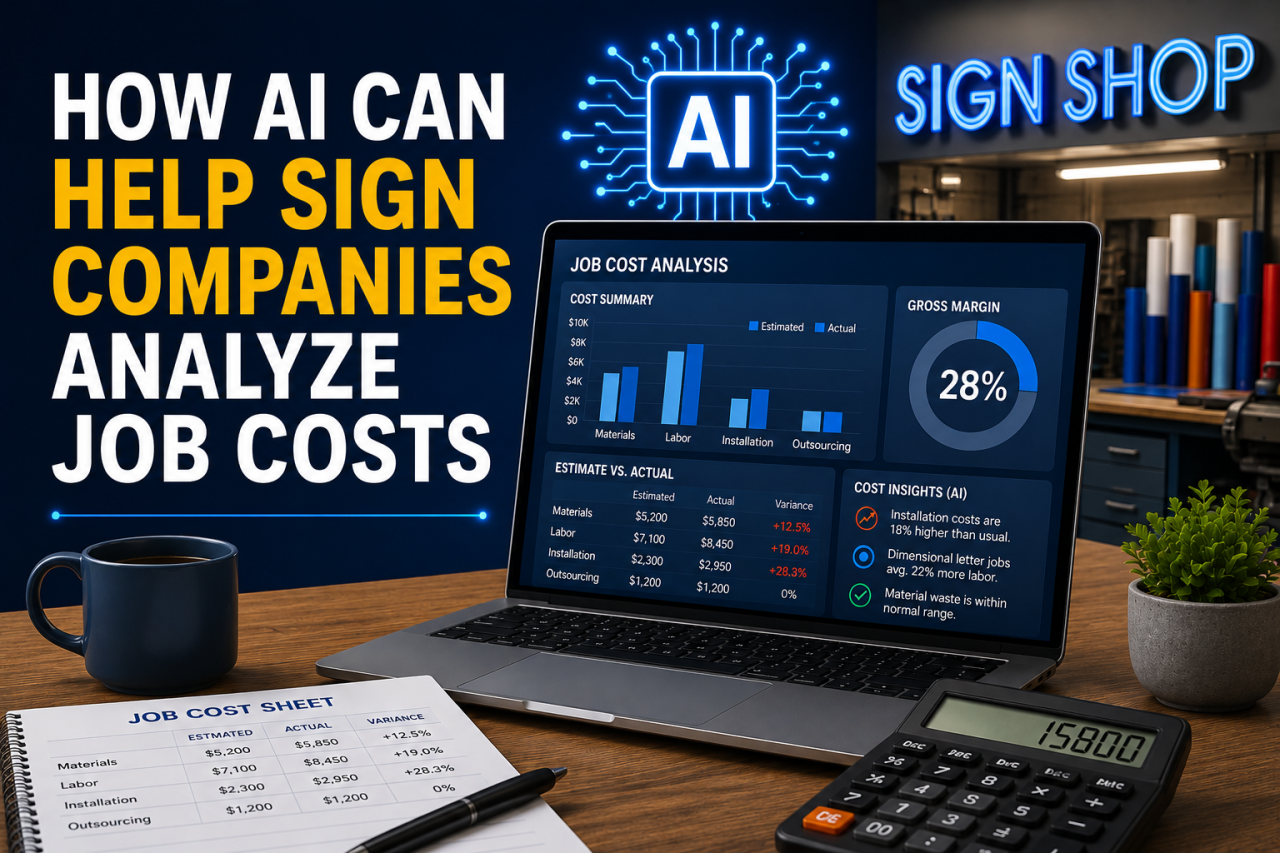
Running a profitable sign company requires more than producing great signs and keeping customers happy. Owners and managers also need to understand exactly what it costs to complete each job.
That sounds simple enough. A company sells a sign for a certain price, subtracts the cost of materials and labor, and the difference represents the profit.
In reality, job costing is rarely that straightforward.
A single sign project might involve estimating, design, permitting, materials, fabrication, printing, finishing, outsourced services, installation, equipment, transportation, and multiple employees. Small changes during production can quickly affect the final cost of the project.
When companies rely on spreadsheets, disconnected systems, or manual calculations, some of those costs can easily be overlooked.
Artificial intelligence is beginning to change that.
AI can help sign companies analyze job-cost data more efficiently, identify patterns that might otherwise go unnoticed, and give managers a clearer understanding of which jobs are actually making money.
The goal isn’t to replace experienced estimators, production managers, or business owners. Instead, AI can help those people make better decisions using information the company is already collecting.
Why Accurate Job Costing Matters
Every sign company needs to answer a basic question:
Did we make money on this job?
Unfortunately, the answer isn’t always obvious.
Imagine a company sells a commercial signage project for $15,000.
The original estimate might include:
- $4,000 in materials
- $3,000 in labor
- $1,000 in installation expenses
- $500 in outside services
On paper, the project appears to have plenty of room for profit.
But during production, several things happen.
The customer requests additional revisions. A panel has to be reprinted. Installation takes six hours longer than expected. Another trip to the jobsite is required. Material prices are slightly higher than they were when the estimate was created.
Individually, these expenses may not seem significant.
Together, they can dramatically change the profitability of the job.
Without accurate job costing, management might never realize what happened.
Worse, the company may quote another similar project using the same assumptions.
The Problem With Traditional Job-Cost Analysis
Many sign companies already collect a significant amount of operational data.
The problem is often figuring out what that data means.
Information may be spread across estimating software, accounting systems, spreadsheets, timecards, purchase orders, production records, inventory systems, and handwritten notes.
A manager might need to manually combine information from several sources simply to determine whether a project was profitable.
That process takes time.
Because of that, detailed job-cost analysis may happen only occasionally.
Managers might review their biggest projects or investigate jobs that obviously went wrong, but hundreds of smaller projects receive little attention.
AI can potentially make that analysis much faster.
Instead of examining one job at a time, AI-powered systems can analyze large numbers of completed projects and look for patterns across them.
Comparing Estimated Costs With Actual Costs
One of the most useful applications of AI in job costing is variance analysis.
Every estimate contains assumptions.
You estimate how much material will be required.
You estimate how many labor hours the project will take.
You estimate installation time.
You estimate outside services.
Once the job is completed, those estimates can be compared with actual results.
For example:
| Cost Category | Estimated | Actual |
|---|---|---|
| Materials | $2,800 | $3,150 |
| Production Labor | $1,900 | $2,600 |
| Installation | $1,200 | $1,850 |
| Outsourcing | $600 | $600 |
A traditional report can show that costs exceeded the estimate.
AI can potentially go further by helping identify patterns behind those differences.
Perhaps projects involving a particular type of installation consistently require more labor than estimated.
Maybe certain fabricated sign products regularly consume more material than expected.
Perhaps projects for a particular type of customer tend to involve more design revisions.
Finding those patterns can help improve future estimates.
Finding Hidden Labor Costs
Labor is one of the most difficult expenses for sign companies to estimate accurately.
Materials are relatively easy to identify. You can calculate the cost of aluminum, acrylic, vinyl, LEDs, paint, mounting hardware, and other components.
Labor is different.
Employees may spend time designing, engineering, printing, routing, welding, painting, assembling, packaging, transporting, and installing the product.
There may also be small amounts of labor that aren’t properly assigned to the job.
Twenty minutes fixing artwork may not seem important.
Neither does another 30 minutes searching for material or an extra hour correcting a production problem.
Across hundreds of jobs, however, those small amounts of time become expensive.
AI analysis can help identify jobs where actual labor consistently exceeds estimated labor.
For example, management might discover that dimensional-letter projects are routinely estimated at 12 production hours but actually average 16.
That information provides an opportunity to improve estimating.
Instead of continuing to quote future jobs based on outdated assumptions, the company can adjust its expected labor requirements.
Identifying Unprofitable Products
Most sign companies produce multiple types of products.
These might include:
- Channel letters
- Monument signs
- Vehicle wraps
- Banners
- ADA signage
- Dimensional lettering
- Wall graphics
- Cabinet signs
- Window graphics
- Digital displays
Revenue reports can show which products generate the most sales.
But sales volume doesn’t necessarily equal profitability.
A company might generate significant revenue from vehicle wraps, for example, while discovering that excessive design revisions and installation labor reduce the actual margins.
Meanwhile, a less glamorous product category might generate much stronger profits.
AI-assisted job-cost analysis can help companies compare profitability across product categories.
Management could examine metrics such as:
Average gross margin by product
Average labor hours per job
Material cost as a percentage of revenue
Average installation cost
Frequency of rework
Estimate-to-actual variance
These insights can influence sales strategy.
A company may decide to increase prices on low-margin products, improve production processes, or focus sales efforts on products that consistently generate stronger returns.
Detecting Cost Overruns Earlier
Traditional job costing often happens after the job is finished.
At that point, the information is useful for learning—but it is too late to change the outcome.
A more advanced system can monitor costs while the project is still active.
Imagine a project was estimated to require 40 production hours.
The job is only halfway through production, but employees have already recorded 35 hours.
That is an obvious warning sign.
AI-powered systems can potentially flag unusual cost patterns before the project is completed.
Managers could receive alerts when:
- Labor exceeds expected progress
- Material usage is unusually high
- Purchase costs exceed the estimate
- Installation hours are increasing rapidly
- Multiple production corrections occur
- Outsourced expenses exceed the original budget
That gives management time to investigate.
Maybe the project encountered an unexpected fabrication problem.
Maybe the estimate was incorrect.
Maybe employees are recording time against the wrong job.
Whatever the cause, identifying the issue during production is much more valuable than discovering it several weeks later.
Improving Future Estimates
Estimating is both a science and an art.
Experienced estimators develop valuable knowledge over many years.
They know how long certain fabrication processes usually take, which installations are likely to be difficult, and where unexpected problems tend to occur.
AI can complement that experience with historical data.
Suppose a company has completed 150 similar monument-sign projects.
An AI system could analyze those projects and identify typical costs for:
- Materials
- Fabrication
- Painting
- Electrical work
- Installation
- Equipment
- Transportation
- Outside services
It could also examine which factors tend to increase costs.
For example, projects requiring long-distance installation might consistently require more labor than expected.
Certain substrates may generate higher waste.
Certain installation environments might require additional equipment.
Historical patterns can give estimators another source of information when preparing future quotes.
Understanding Material Waste
Material waste is another area where profitability can quietly disappear.
Printing, routing, cutting, fabrication, and installation all generate waste.
Some waste is unavoidable.
But excessive waste may indicate problems with production planning, equipment, purchasing, or employee training.
AI analysis could compare expected material consumption with actual material usage across many projects.
If similar jobs normally require four sheets of material but frequently consume five, management has something worth investigating.
The cause might be:
- Poor nesting
- Incorrect production files
- Printing errors
- Equipment calibration problems
- Material damage
- Measurement mistakes
- Rework
Reducing even a small amount of material waste across hundreds of jobs can have a meaningful impact on profitability.
Discovering Which Customers Are Most Profitable
Companies often evaluate customers based on revenue.
But the customer generating the most revenue isn’t necessarily the most profitable customer.
Some customers require significantly more administrative effort.
They may request frequent design revisions, change specifications after production begins, require complicated billing procedures, or schedule installations that require additional coordination.
AI-assisted analysis can potentially examine profitability by customer.
Instead of asking:
Which customers spend the most money with us?
Management can ask:
Which customers generate the strongest margins?
Those are very different questions.
A $250,000 customer with poor margins and significant administrative requirements may ultimately be less valuable than a $150,000 customer whose projects are standardized, predictable, and profitable.
Understanding that difference can influence pricing, account management, and sales priorities.
Analyzing Rework
Rework is one of the biggest hidden costs in manufacturing environments.
A sign may need to be remade because of an incorrect measurement.
Graphics may need to be reprinted.
A fabrication error may require additional labor.
Installation crews may have to return to a jobsite.
Each event consumes time and materials.
The challenge is recognizing whether these are isolated incidents or part of a larger pattern.
AI can analyze rework across many jobs and help identify recurring causes.
For example, management might discover that a significant percentage of rework originates during the design-approval process.
That insight could lead to better proofing procedures.
Another company might discover that field-measurement errors are responsible for repeated production problems.
That could justify additional training or a standardized site-survey process.
AI doesn’t fix the problem automatically.
It helps management identify where to look.
Better Purchasing Decisions
Purchasing data is closely connected to job costing.
If material prices increase but estimating templates aren’t updated, profit margins can slowly decline.
This is especially dangerous because the change may happen gradually.
A material that once cost $100 might increase to $108, then $115, then $125.
If estimates still assume the original cost, every job using that material becomes slightly less profitable.
AI-assisted systems can analyze purchasing history and identify changing cost trends.
Companies can then update estimating assumptions before outdated material costs affect dozens of projects.
Turning Job Data Into Management Information
One of the biggest advantages of AI isn’t necessarily prediction.
It’s interpretation.
Sign companies already generate enormous amounts of operational information.
The challenge is converting that information into something managers can actually use.
Instead of reviewing dozens of reports, a manager could potentially ask questions such as:
Which jobs had the largest labor overruns this quarter?
Which product category had the highest average margin?
Which jobs required the most rework?
Where are material costs increasing fastest?
Which types of installations consistently exceed estimates?
Which customers generated the strongest gross margins?
That makes business intelligence much more accessible.
Managers don’t necessarily need to become data analysts.
They need systems that help them understand what their business data is telling them.
AI Depends on Good Data
There is an important limitation.
AI cannot magically fix inaccurate business information.
If employees don’t record their time properly, labor analysis will be unreliable.
If purchase orders aren’t connected to jobs, material costs may be incomplete.
If rework isn’t documented, the system cannot accurately analyze it.
If estimates aren’t structured consistently, comparisons become difficult.
In other words:
Better AI starts with better operational data.
Sign companies interested in AI should first make sure they have reliable processes for tracking:
- Labor
- Materials
- Purchases
- Estimates
- Production activity
- Installation
- Rework
- Outside services
- Job completion
- Revenue
The more connected that information becomes, the more useful AI analysis can be.
From Reactive Management to Proactive Management
Many businesses manage profitability reactively.
A problem becomes obvious.
Margins decline.
Cash flow gets tighter.
A large project loses money.
Management investigates what happened.
AI-assisted job costing creates the possibility of a more proactive approach.
Instead of waiting for profitability problems to become obvious, companies can look for early warning signs.
Small labor overruns can be identified before they become normal.
Material-cost increases can be detected before pricing becomes outdated.
Unprofitable product categories can be investigated before the company invests additional sales resources into them.
Patterns of rework can be addressed before they affect dozens of future jobs.
That shift—from reacting to problems to identifying patterns earlier—may ultimately be one of AI’s most valuable contributions to sign-company management.
The Competitive Advantage of Better Job-Cost Data
Sign companies compete on many things.
Quality matters.
Service matters.
Turnaround time matters.
Price matters.
But behind all of those factors is another capability that customers rarely see:
Operational intelligence.
Companies that understand their costs can price jobs more confidently.
They can identify inefficient processes.
They can recognize profitable opportunities.
They can invest in the right equipment.
They can determine which products deserve more attention.
And they can make those decisions based on actual business data rather than assumptions.
AI makes it possible to analyze that information at a scale that would be difficult to accomplish manually.
The Future of AI and Job Costing
AI won’t eliminate the need for experienced sign professionals.
If anything, it can make their experience more valuable.
A production manager may immediately understand why a certain project consumed additional labor.
An estimator may recognize why a particular installation exceeded expectations.
An owner may understand the customer relationship behind unusual project costs.
AI provides another layer of information that helps those people make decisions.
The combination of industry experience and better data analysis can create a much clearer picture of business performance.
Better Data Leads to Better Decisions
Every completed sign project contains valuable information.
It tells you something about your estimating accuracy.
It tells you something about your production efficiency.
It tells you something about your material costs.
It tells you something about your labor requirements.
And ultimately, it tells you something about your profitability.
The problem is that most companies complete thousands of jobs over time, making it nearly impossible for managers to manually analyze every project.
AI can help change that.
By analyzing historical job data, comparing estimates with actual costs, identifying unusual variances, and uncovering recurring patterns, AI can help sign companies understand where they make money—and where profits may be slipping away.
For sign companies, the opportunity isn’t simply to adopt AI because it’s a new technology.
The real opportunity is to use AI to answer one of the most important questions in business:
What is actually making us money?
Companies that can answer that question accurately are in a much stronger position to improve pricing, control costs, increase margins, and build a more profitable operation.