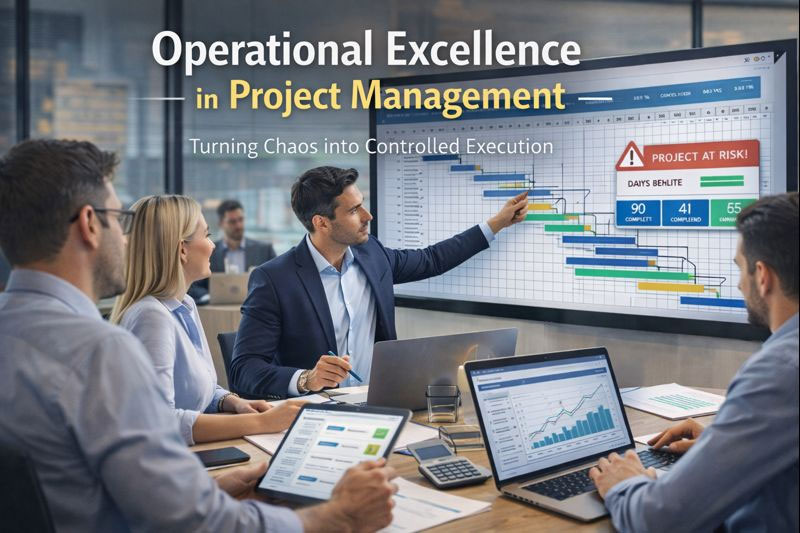
How Project Management Systems Protect Margins, Timelines, and Trust
Project management is where strategy either becomes reality—or quietly falls apart. Sales may win the deal, but projects determine whether that deal is profitable, repeatable, and scalable. Organizations that struggle with execution often believe they have a people problem. In truth, they have a systems problem.
Operational Excellence in project management is about replacing chaos, heroics, and constant course correction with clarity, discipline, and predictable execution. When done well, project management doesn’t just keep work on track—it becomes a competitive advantage.
The What: What Operational Excellence in Project Management Really Is
At its core, Operational Excellence in project management means having a repeatable framework that governs how work moves from commitment to completion—every time, regardless of project size, customer, or team member.
It ensures that:
-
Scope is clearly defined and protected
-
Work is broken into actionable steps
-
Ownership is explicit, not assumed
-
Progress is visible in real time
-
Deviations are caught early, not after damage is done
This is not about adding bureaucracy. It’s about reducing friction.
Excellent project management removes ambiguity. Ambiguity is expensive. It causes rework, delays, internal tension, and customer dissatisfaction. Structure replaces ambiguity with confidence.
The Why: Why Most Projects Fail (and Why It’s Not What You Think)
Projects rarely fail because teams aren’t working hard enough. They fail because:
-
Tasks aren’t clearly defined
-
Dependencies aren’t visible
-
Timelines are optimistic guesses
-
Issues surface too late to fix cheaply
In unstructured environments, success depends on a few key people “holding everything together.” This works—until it doesn’t. When those individuals are overloaded, unavailable, or leave, the system collapses.
The Hidden Cost of Poor Project Management
The financial impact is often underestimated:
-
Labor overruns that aren’t tracked until invoicing
-
Scope creep absorbed “to keep the customer happy”
-
Delays that ripple into other jobs
-
Missed deadlines that erode trust
These costs don’t always show up as a single line item. They show up as shrinking margins, burned-out teams, and customers who quietly don’t come back.
Operational Excellence addresses this by shifting project management from reactive problem-solving to proactive control.
The How: Building a Project Management System That Actually Works
1. Standardize the Way Work Is Defined
Every project should start the same way:
-
A clearly defined scope
-
A breakdown of deliverables
-
Agreed-upon milestones
This doesn’t eliminate flexibility—it creates a baseline. When change happens (and it will), teams can see exactly what’s changing and why.
Standardization allows leaders to answer critical questions instantly:
-
Where are we ahead or behind?
-
Which projects are at risk?
-
What capacity do we actually have?
Without standard definitions, every project becomes a custom interpretation—and chaos follows.
2. Break Projects into Managed, Trackable Components
Operational Excellence depends on breaking work down into:
-
Tasks with owners
-
Dependencies that enforce sequence
-
Timelines based on reality, not hope
This creates momentum. People don’t stall because they don’t know what’s next. Work flows.
Technology enables this by automatically generating task structures based on project type. Instead of reinventing the wheel each time, teams execute proven workflows.
3. Make Progress and Problems Visible in Real Time
One of the most damaging myths in project management is that “no news is good news.” In reality, silence often means problems are growing unnoticed.
A well-designed project management system provides:
-
Real-time status updates
-
Alerts when tasks stall
-
Visibility into workload and capacity
This allows managers to intervene early—when fixes are cheap and simple.
Visibility replaces status meetings. Instead of asking “Where are we?” leaders can focus on “What do we need to adjust?”
4. Integrate Time and Cost Tracking into the Workflow
Projects don’t lose money at the end—they lose money gradually.
When time and costs are tracked in isolation (or not at all), overruns are discovered too late. By integrating labor and cost tracking directly into project execution, organizations gain margin awareness while work is still happening.
This enables:
-
Mid-project corrections
-
Better pricing decisions in the future
-
Continuous improvement of estimates
Operational Excellence turns every project into a learning asset.
The Role of Technology—and Why It Matters
Technology is not the solution by itself. It is the enforcement mechanism for good process.
Modern project management platforms:
-
Automate task creation
-
Enforce dependencies
-
Eliminate manual handoffs
-
Centralize communication and documentation
This reduces cognitive load. Teams stop managing the system and start doing the work.
When project management is integrated with sales, accounting, and production systems, handoffs become seamless. Information flows instead of being re-entered, reinterpreted, or lost.
Where AI Fits into Project Excellence
AI does not replace project managers. It augments them.
When layered onto structured project data, AI can:
-
Predict schedule slippage
-
Identify resource bottlenecks
-
Flag abnormal cost patterns
-
Recommend workload adjustments
But AI only works when the underlying process is disciplined. Without clean inputs, AI produces noise—not insight.
Organizations that benefit from AI are those that already respect process.
The ROI: Why Better Project Management Pays for Itself
Investing in structured project management often includes:
-
Software implementation
-
Process redesign
-
Training and change management
The return comes quickly:
-
Fewer overruns
-
Higher on-time delivery rates
-
Improved customer satisfaction
-
Reduced burnout and turnover
Even a modest reduction in project overruns can translate into six-figure annual savings for mid-sized organizations.
Efficiency here doesn’t just protect margins—it enables growth without adding chaos.
The Strategic Reality
As organizations grow, informal coordination breaks down. What once worked through proximity and memory no longer scales.
Operational Excellence in project management is the difference between:
-
Growth that compounds
-
Growth that collapses under its own weight
Structure doesn’t slow teams down. It removes friction, uncertainty, and rework—the real enemies of speed.