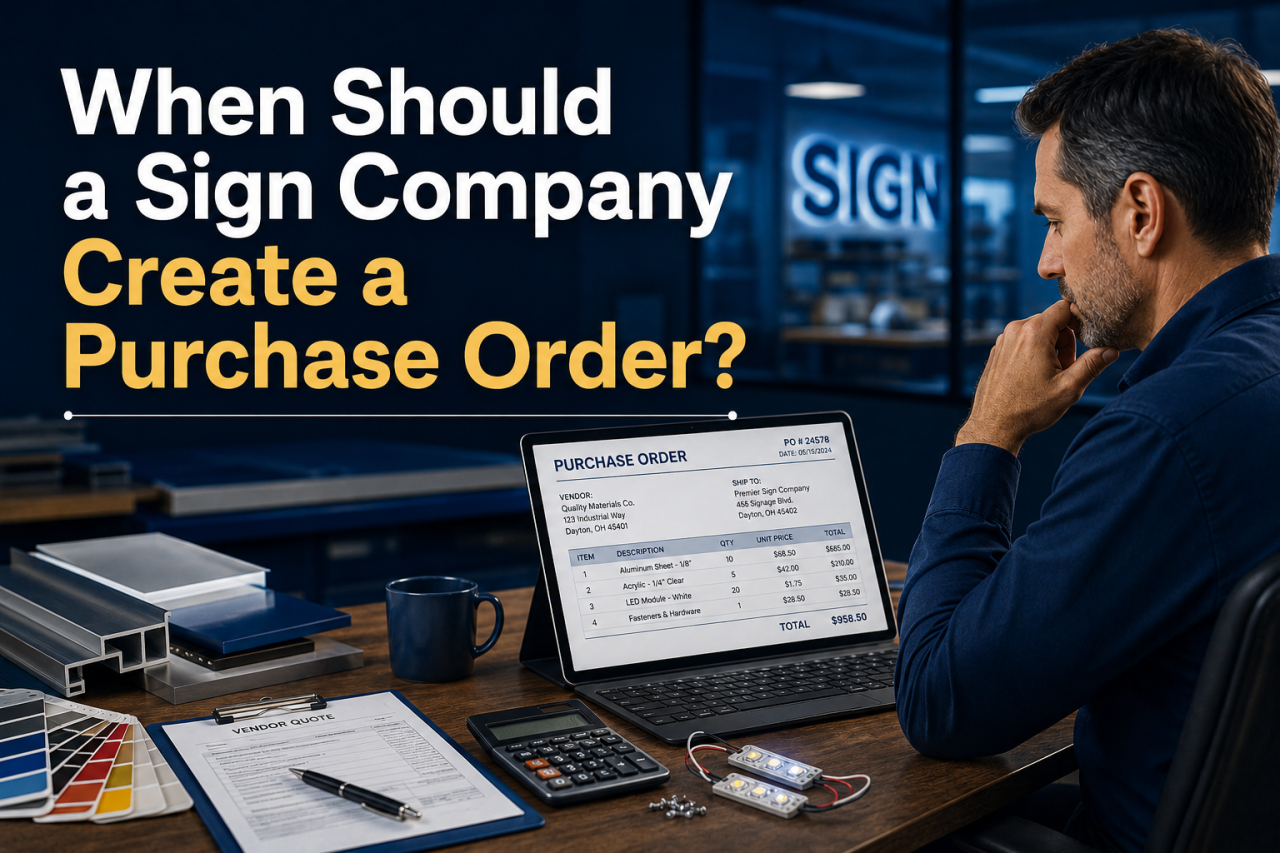
Purchase orders are an essential part of financial control for sign companies, but many businesses do not create them at the right time—or use them consistently.
Some purchase orders are created only after a vendor invoice arrives. Others are issued before the scope of a project has been finalized. In some shops, purchasing decisions are documented through emails, text messages, handwritten notes, or verbal conversations. These methods may work when a company is small, but they become increasingly risky as sales volume, project complexity, and vendor spending grow.
The timing of a purchase order matters because it determines whether the document is being used as a true purchasing control or simply as an administrative record.
In most cases, a sign company should create a purchase order after the job requirements and purchasing authority have been confirmed, but before the order is placed with the vendor. However, there are several important exceptions and operational considerations.
Understanding these situations can help sign companies control spending, protect job margins, improve material planning, and create more accurate job-costing records.
What Is a Purchase Order?
A purchase order, commonly called a PO, is a formal document that authorizes a vendor purchase. It identifies what the company intends to buy, how much it expects to pay, where the items should be delivered, and which project or department is responsible for the expense.
A typical purchase order includes:
- A unique PO number
- The vendor’s name and contact information
- The requested items or services
- Descriptions and specifications
- Quantities
- Unit costs
- Expected total cost
- Delivery instructions
- Required delivery date
- Payment terms
- The associated customer job or work order
- The employee who requested or approved the purchase
The PO creates a shared record between the sign company and the vendor. It also gives accounting, purchasing, production, and project management teams a common reference point.
More importantly, it records a financial commitment before the money is spent.
The Best Time to Create a Purchase Order
The ideal time to create a purchase order is after the company has confirmed what it needs and received the appropriate internal approval, but before someone commits to the purchase.
The recommended sequence is:
- Confirm the customer’s order or internal purchasing need.
- Finalize the relevant specifications and quantities.
- Review inventory to determine what must be purchased.
- Obtain vendor pricing or a quote when necessary.
- Verify that the cost fits the job budget.
- Secure internal approval.
- Create and send the purchase order.
- Have the vendor confirm pricing and availability.
This timing gives the business an opportunity to catch mistakes before they become expenses.
If a PO is created too early, the project’s quantities, materials, dimensions, colors, or delivery requirements may still change. If it is created too late, the vendor order may already be in production or noncancelable.
A purchase order should therefore represent an approved decision—not a rough idea and not a reconstruction of something that has already happened.
Create a PO When Ordering Job-Specific Materials
One of the clearest reasons to create a purchase order is when buying materials specifically for a customer job.
Examples may include:
- Aluminum sheets
- Acrylic panels
- Channel-letter components
- LED modules and power supplies
- Custom paint
- Specialty vinyl
- Printed graphics
- Frames or mounting systems
- Electrical components
- Installation hardware
The PO should be linked to the customer’s order, project, or work order whenever possible. That connection allows the purchasing expense to become part of the job’s actual cost.
Without this connection, a material purchase may be recorded only as a general company expense. Management may know how much the company spent overall, but not which project consumed the material.
Job-specific purchasing becomes especially important when a sign company produces highly customized work. Two signs that appear similar to a customer may require very different substrates, finishes, structural components, electrical systems, and installation methods.
A properly assigned PO makes those differences visible in the financial record.
Create a PO Before Ordering Outsourced Work
Purchase orders should also be created before subcontracting any part of a project.
Sign companies frequently outsource services such as:
- Engineering
- Permitting
- Surveys
- Excavation
- Electrical work
- Crane service
- Installation
- Welding
- Routing
- Printing
- Painting
- Freight
- Specialty fabrication
These services can have a major impact on job profitability. If their costs are not documented until invoices arrive, project managers may unknowingly commit the company to expenses that exceed the estimate.
A PO establishes the approved scope and price before the subcontractor begins work.
For example, an installation purchase order might specify the installation address, scheduled date, equipment requirements, estimated hours, permit responsibilities, cleanup expectations, and maximum approved price. If the installer encounters unexpected site conditions, the additional work can be documented and approved as a change instead of becoming a surprise on the final invoice.
Create a PO for Inventory Replenishment
Not every purchase order needs to be associated with a single customer job. Sign companies should also create POs when replenishing commonly stocked materials.
These purchases might include:
- Standard vinyl colors
- Frequently used aluminum
- Common fasteners
- Electrical supplies
- Packaging materials
- Printer ink
- Application tape
- Cleaning supplies
- Shop consumables
The timing of these purchase orders should be based on real inventory requirements rather than habit or guesswork.
Mothernode’s inventory workflow connects purchasing decisions with production activity. Materials remain uncommitted while an order is still open and are deducted when the order moves into production. This helps buyers work from more accurate information about what is available and what has been committed. Learn more about inventory processing in Mothernode.
When inventory records are current, purchasing teams can create replenishment POs based on minimum stock levels, upcoming production demand, lead times, and economic order quantities.
This reduces two costly problems: running out of critical materials and carrying more inventory than the company needs.
Create a PO for Large or Unusual Expenses
A sign company should require purchase orders for significant expenses even when those purchases are not directly related to production.
Examples include:
- New equipment
- Computer hardware
- Software
- Vehicle repairs
- Building maintenance
- Office furniture
- Professional services
- Marketing materials
- Safety equipment
- Tools
The business may establish a dollar threshold that determines when a PO is mandatory. An employee might be allowed to make a small shop purchase without a formal PO, while any expense over a specified amount requires approval.
The exact threshold will depend on the company’s size and operating structure. What matters is that the policy is clear, consistently enforced, and understood by both employees and vendors.
What If the Customer Has Not Approved the Job?
In general, a sign company should avoid issuing a standard, noncancelable purchase order for custom materials before the customer approves the project.
Ordering too soon can leave the company responsible for materials it cannot reuse or return.
However, waiting for final approval is not always practical. Long-lead components, permitting deadlines, or tight installation schedules may require early purchasing.
In those situations, the company should evaluate the financial risk and use a controlled process. Possible safeguards include:
- Collecting a customer deposit
- Obtaining written authorization for early purchasing
- Issuing a limited PO only for long-lead materials
- Confirming cancellation and restocking terms
- Separating preliminary purchases from the full production order
- Getting management approval for the exposure
The goal is to move the project forward without allowing schedule pressure to bypass financial controls.
Should a PO Be Created Before or After a Vendor Quote?
For nonstandard purchases, the vendor quote should usually come first.
The quote helps the buyer verify pricing, availability, freight, taxes, turnaround time, and payment terms. Once the quote has been reviewed and approved, the company can convert the information into a purchase order.
The PO then becomes the sign company’s authorization to proceed.
Sending a vendor quote back with “approved” written in an email may appear sufficient, but it often lacks a job number, internal approval record, delivery location, or standardized terms. Creating a PO ensures that the commitment enters the company’s purchasing and accounting workflow.
For routine items covered by negotiated pricing, the company may not need a new quote every time. A PO should still be created to document the quantity, delivery requirements, and job assignment.
Why Creating a PO After the Invoice Arrives Is Too Late
A purchase order created after receiving the vendor invoice is sometimes called a confirming or after-the-fact PO.
Although it may help accounting enter the bill, it does not provide meaningful purchasing control. The company has already incurred the expense.
At that point, it is too late to:
- Compare the cost with the job budget
- Obtain competitive quotes
- Correct an incorrect quantity
- Prevent an unauthorized purchase
- Negotiate better terms
- Confirm the delivery schedule
- Stop duplicate orders
- Resolve unclear specifications before production
Frequent after-the-fact POs are usually a sign of a broken workflow. Employees may not know the purchasing policy, approval takes too long, or the company may lack a centralized system.
Occasional exceptions will happen, particularly during emergencies. They should be reviewed so that exceptions do not become the normal process.
How Purchase Orders Protect Job Profitability
A purchase order is more than an accounting document. It is part of the job-costing process.
Suppose a sign project includes an estimated $6,000 in purchased materials and outsourced services. During production, the team issues POs totaling $7,800. If purchasing data is connected to the job, management can see the developing cost overrun before the project is complete.
The team can then investigate:
- Were quantities underestimated?
- Did the customer change the scope?
- Did vendor prices increase?
- Was material reordered because of waste?
- Was freight omitted from the estimate?
- Did the company select a more expensive component?
- Should the customer receive a change order?
Without timely POs, these questions may not surface until after the final vendor bills have been entered—and possibly after the customer has been invoiced.
Detailed estimating makes these comparisons even more useful. Mothernode’s Freeform BOM workflow, for example, can establish budgeted materials and labor before production, allowing companies to compare expected and actual costs and identify variances. See Mothernode’s explanation of budgeted versus actual job costing.
Use Purchase Orders to Prevent Common Errors
A disciplined PO process can prevent several everyday purchasing problems.
Duplicate purchases
Two employees may order the same material because neither knows the other has already contacted the vendor. A centralized PO record makes outstanding orders visible.
Incorrect specifications
Written descriptions, part numbers, colors, dimensions, and artwork references reduce dependence on verbal instructions.
Delivery confusion
The PO can state whether materials should go to the main facility, a branch, an installer, or directly to the job site.
Pricing discrepancies
Accounting can compare the vendor invoice with the approved PO instead of assuming every billed amount is correct.
Unassigned costs
Requiring a job number, department, or expense category prevents purchases from becoming unidentified overhead.
Unauthorized spending
Approval rules ensure that employees cannot commit the company beyond their purchasing authority.
Receiving and Matching the Purchase
Creating the PO is only the beginning. The company should also verify what happens afterward.
When materials arrive, the receiving employee should compare the shipment with the PO and record:
- Items received
- Quantities received
- Damaged or missing items
- Partial shipments
- Backordered items
- Delivery date
- Packing slip information
Accounting can then compare three records:
- The purchase order
- The receiving record
- The vendor invoice
This is commonly called three-way matching.
If all three agree, the invoice can move toward payment. If they do not, the company can investigate the difference before paying.
For service purchases, a project manager or authorized employee can confirm that the work was completed as agreed.
Handling Changes to an Existing PO
Sign projects change frequently, so purchase orders need a controlled revision process.
If a vendor’s price, quantity, scope, or delivery terms change, the original PO should not simply be ignored. The company should update it or issue a documented change.
Important revisions may include:
- Adding material
- Changing a component
- Approving expedited freight
- Increasing subcontractor hours
- Changing the delivery address
- Accepting a vendor price increase
- Canceling an item
The revised amount may require additional approval, especially if it exceeds the original job budget or the buyer’s authorization limit.
Maintaining a clear revision history helps everyone understand which commitment is current.
Building an Effective Purchase Order Policy
A practical PO policy should answer five questions:
- Which purchases require a PO?
- Who may request a purchase?
- Who must approve it?
- When must the PO be created?
- How are receipts, invoices, and changes handled?
The policy should be strong enough to control risk but simple enough for employees to follow.
If creating a PO requires excessive paperwork or days of waiting, employees may look for ways around the process. Business management software can make the workflow faster by connecting sales orders, production needs, inventory, vendors, purchasing, and job costing in one environment.
Mothernode is designed to give sign companies a connected operational platform spanning estimating, project management, manufacturing, inventory, purchasing, and financial visibility. This shared information helps teams make purchasing decisions using current job and production data rather than disconnected spreadsheets or informal messages. Explore Mothernode’s platform for the signage industry.
The Bottom Line
A sign company should create a purchase order when the need, specifications, pricing, job assignment, and authorization are sufficiently clear—and always before making a commitment to the vendor.
Purchase orders should be used for job-specific materials, outsourced services, inventory replenishment, major expenses, and any other purchase that requires financial oversight.
Created at the right time, a PO helps prevent unauthorized spending, improves communication with vendors, supports accurate inventory planning, and connects actual purchasing costs to the jobs that generated them.
The most important principle is simple: a purchase order should guide and control a purchase, not merely document it after the money has already been spent.
For growing sign companies, establishing that discipline can mean the difference between estimating profitability and actually achieving it.