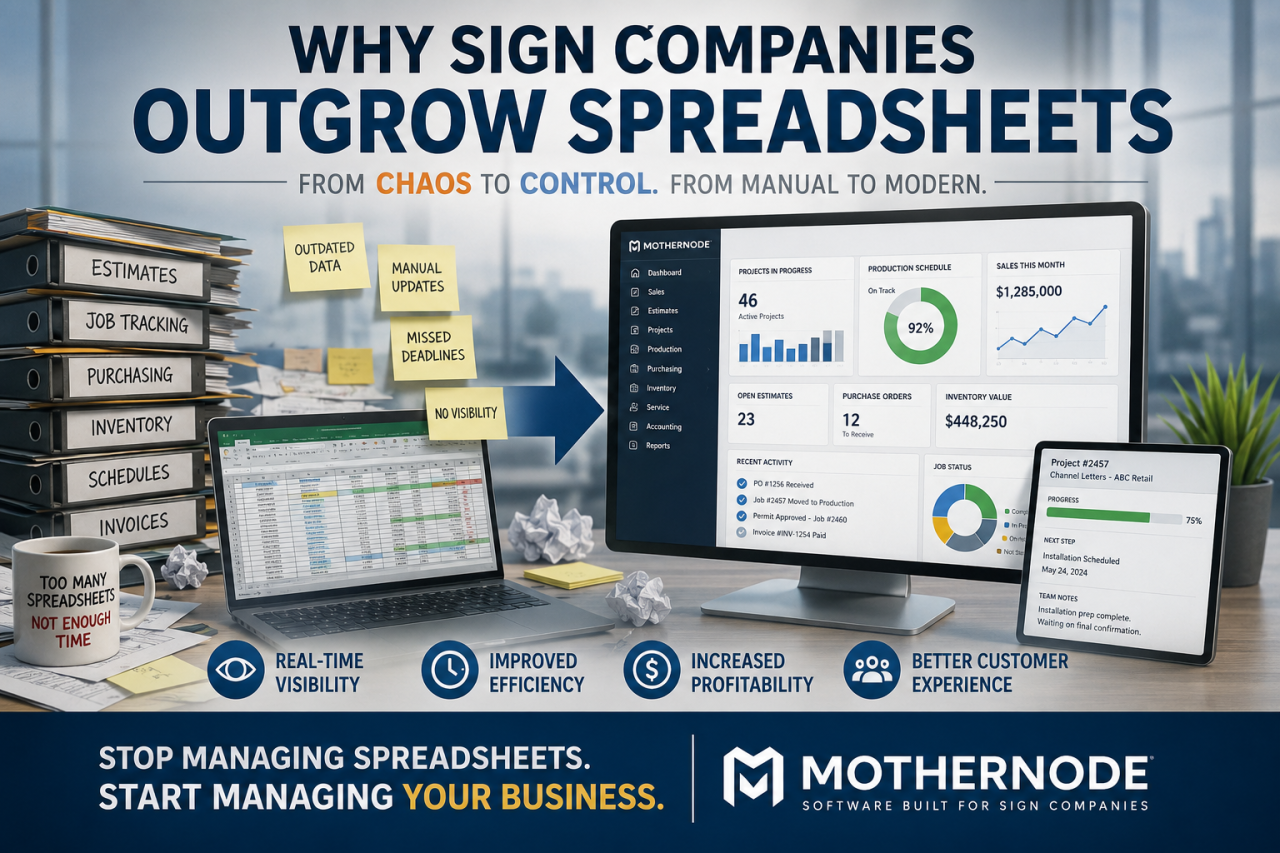
For many sign companies, spreadsheets are where the business begins.
They are inexpensive, familiar, and flexible enough to track estimates, customer information, production schedules, purchasing, and invoices. A growing sign shop can operate successfully with Excel or Google Sheets for years, especially when the team is small and everyone knows where everything is.
But growth changes everything.
As new employees join the company, customer demands become more complex, and projects become larger, spreadsheets begin showing their limitations. What once seemed like an organized system slowly becomes a collection of disconnected files, duplicated information, manual processes, and constant firefighting.
Eventually, many sign companies reach the same conclusion: they haven’t outgrown their business—they’ve outgrown their spreadsheets.
The difference between a business that struggles to scale and one that continues growing often comes down to having the right operational systems in place.
The Hidden Cost of Spreadsheet Management
Most sign companies don’t wake up one morning and decide to replace spreadsheets. Instead, they slowly accumulate dozens—or even hundreds—of them.
One spreadsheet tracks estimates.
Another manages active jobs.
Another keeps vendor pricing.
Someone has a purchasing spreadsheet.
Accounting has another file for invoices.
Production maintains its own schedule.
Installers have printed copies because the spreadsheet isn’t available in the field.
The result isn’t just multiple spreadsheets. It’s multiple versions of the truth.
Every time information changes, someone has to update it in several places. Every manual update introduces the possibility of mistakes.
A customer’s installation date changes.
Did production get notified?
Did purchasing see the new deadline?
Was the installation crew informed?
Did accounting know the project timeline changed?
If any one of those updates is missed, the entire project can be affected.
The cost isn’t just administrative. It impacts customer satisfaction, profitability, employee morale, and ultimately business growth.
Growth Makes Complexity Multiply
A company completing five projects at a time can often manage with spreadsheets.
A company handling fifty simultaneous projects faces a completely different challenge.
Every project involves dozens—or even hundreds—of moving parts:
- Sales opportunities
- Customer communications
- Site surveys
- Artwork approvals
- Engineering
- Permits
- Material purchasing
- Manufacturing
- Quality control
- Scheduling
- Installation
- Service
- Billing
Each stage depends on the previous one being completed accurately and on time.
Trying to coordinate these workflows inside spreadsheets quickly becomes overwhelming.
Instead of helping employees stay organized, spreadsheets require employees to spend valuable time searching for information, updating cells, emailing revisions, and confirming that everyone is working from the latest version.
Growth doesn’t just increase workload.
It multiplies complexity.
Information Lives in Too Many Places
One of the biggest operational challenges sign companies face is fragmented information.
Customer notes may exist in email.
Artwork might be stored in shared folders.
Purchase orders are somewhere else.
Invoices live in accounting software.
Installation photos are saved on someone’s phone.
Project timelines are tracked in spreadsheets.
Finding information often means asking multiple people.
“Who has the latest drawing?”
“Did purchasing order the aluminum?”
“Has the permit been approved?”
“Where’s the installation schedule?”
Every interruption costs time.
Every search reduces productivity.
Modern sign management software centralizes information so every department works from the same source.
Instead of hunting for answers, employees spend their time completing projects.
Manual Processes Don’t Scale
Every manual process eventually reaches a breaking point.
Entering customer information multiple times.
Copying estimates into production schedules.
Updating spreadsheets after every phone call.
Sending emails to notify departments.
Creating purchase orders manually.
Building reports every Friday afternoon.
None of these activities generate revenue.
They’re administrative work created because the systems aren’t connected.
As companies grow, manual work increases faster than revenue.
Eventually, employees spend more time managing data than serving customers.
Automation changes that equation.
When information flows automatically between departments, employees can focus on higher-value work instead of repetitive data entry.
Visibility Becomes a Competitive Advantage
Ask a growing sign company owner a simple question:
“What is the status of every active project right now?”
With spreadsheets, answering that question often requires multiple phone calls.
Managers may need to speak with sales, production, purchasing, and installation before giving an accurate answer.
That’s valuable time lost.
Modern sign management software provides real-time visibility across the organization.
Project status.
Material availability.
Production schedules.
Outstanding approvals.
Pending invoices.
Installation dates.
Instead of reacting to problems after they happen, managers can identify bottlenecks before they impact customers.
Visibility allows better decisions.
Better decisions create better customer experiences.
Missed Deadlines Become Expensive
Deadlines matter in the sign industry.
Retail openings.
Corporate rebranding.
Franchise rollouts.
Construction schedules.
Municipal requirements.
A missed installation date can create ripple effects that cost thousands of dollars.
When deadlines are managed through spreadsheets, they often rely on individuals remembering to update dates or send notifications.
People get busy.
Files don’t get updated.
Deadlines slip.
Customers become frustrated.
Integrated project management automatically tracks milestones, alerts teams to upcoming deadlines, and helps ensure everyone stays aligned throughout the project lifecycle.
Communication Shouldn’t Depend on Email Chains
Email is excellent for communication.
It is not an effective project management system.
Many sign companies rely on endless email conversations to coordinate projects.
The problem?
Important information becomes buried.
New employees cannot easily understand project history.
Attachments become outdated.
Different departments have different versions of the same conversation.
Centralized project communication keeps discussions attached directly to the job.
Everyone sees the same updates.
Everyone works from the same information.
Nothing gets lost in someone’s inbox.
Inventory Control Is More Difficult Than It Appears
Materials represent a significant investment for sign companies.
Aluminum.
ACM.
Vinyl.
LED components.
Electrical supplies.
Fasteners.
Paint.
Hardware.
Without accurate inventory visibility, companies often experience one of two costly problems.
They overstock materials, tying up cash in inventory.
Or they understock critical components, delaying production and installation.
Spreadsheet inventory management depends on consistent manual updates.
Reality rarely works that way.
Integrated inventory systems provide real-time tracking that helps purchasing make smarter decisions while reducing waste and shortages.
Reporting Shouldn’t Take Days
Business owners need answers quickly.
Which customers generate the highest profit?
Which jobs are behind schedule?
How much work is currently in production?
Which departments are overloaded?
What are monthly sales trends?
With spreadsheets, these reports often require hours—or days—of manual preparation.
By the time they’re complete, the information may already be outdated.
Modern ERP software generates dashboards and reports in real time.
Leaders gain immediate insight into business performance without waiting for someone to build another spreadsheet.
Customer Expectations Continue to Rise
Today’s customers expect transparency.
They want faster responses.
More accurate timelines.
Better communication.
Fewer mistakes.
Meeting those expectations becomes increasingly difficult when employees spend half their day updating spreadsheets instead of serving customers.
Technology doesn’t replace customer service.
It enables better customer service.
When employees have instant access to information, they answer questions faster, solve problems more quickly, and deliver a more professional experience.
Hiring Becomes Easier with Better Systems
Growing companies often struggle to onboard new employees.
Spreadsheet-based businesses depend heavily on tribal knowledge.
Experienced employees know where everything is.
New employees do not.
Training takes longer because processes aren’t standardized.
Modern software creates consistency.
Workflows become repeatable.
Information is centralized.
Tasks are documented.
New employees become productive faster, reducing onboarding costs and improving operational efficiency.
Decision Making Requires Accurate Data
Business decisions are only as good as the information behind them.
If reports rely on outdated spreadsheets or manually entered numbers, leaders risk making decisions based on incomplete or inaccurate information.
Integrated systems provide live operational data that reflects what’s actually happening across the business.
Whether evaluating profitability, forecasting workload, planning staffing, or identifying production bottlenecks, real-time data leads to more confident decisions.
Security and Version Control Matter
How many versions of the same spreadsheet exist in your company?
“Final.xlsx”
“Final Version 2.xlsx”
“Updated Final.xlsx”
“Really Final.xlsx”
It sounds humorous, but version confusion causes real operational problems.
Employees accidentally update outdated files.
Critical formulas get deleted.
Someone overwrites important information.
Cloud-based business management software maintains one authoritative version of every record while controlling user permissions and maintaining detailed audit histories.
Everyone works from the same data.
Scaling Shouldn’t Mean Adding Administrative Staff
Many businesses unintentionally solve growth problems by hiring more administrative employees.
More coordinators.
More data entry.
More project assistants.
More people updating spreadsheets.
This approach increases overhead without necessarily increasing productivity.
The better solution is improving the process itself.
Automation allows existing employees to manage significantly more work without sacrificing quality or customer service.
Technology enables growth without requiring administrative costs to grow at the same rate.
Integration Eliminates Duplicate Work
One of the greatest advantages of purpose-built sign management software is integration.
Instead of separate systems for sales, estimating, production, purchasing, inventory, accounting, service, and reporting, information flows seamlessly between departments.
An approved estimate becomes a job.
The job generates purchasing needs.
Purchasing updates inventory.
Production schedules automatically reflect material availability.
Installation teams receive current project information.
Accounting invoices from completed work.
One source of information.
One workflow.
One system.
Why Industry-Specific Software Makes the Difference
Generic business software often requires extensive customization because it wasn’t designed for the unique workflows of sign manufacturers and sign service providers.
The sign industry has specialized requirements, including estimating, permitting, fabrication, installation scheduling, service management, national account support, project tracking, and complex production coordination.
Industry-specific software understands those workflows from the beginning.
Instead of forcing sign companies to adapt to generic software, specialized solutions are built around how sign businesses actually operate.
That translates into faster implementation, greater adoption, and stronger long-term value.
The Mothernode Advantage
Mothernode was developed specifically for the sign industry, providing a unified platform that connects the entire operation—from sales and estimating to production, inventory, installation, service, and accounting.
Rather than relying on disconnected spreadsheets and manual processes, sign companies gain a centralized system designed around the real-world challenges they face every day.
Teams can collaborate more effectively because everyone works from the same information. Managers gain real-time visibility into operations, helping them identify bottlenecks, monitor project progress, and make informed decisions based on current data instead of outdated reports.
As businesses grow, Mothernode helps maintain consistency, improve communication, reduce manual work, and create scalable processes that support continued expansion.
Instead of adding complexity as the company grows, organizations gain the structure needed to manage larger workloads with greater confidence.
The Bottom Line
Spreadsheets are excellent tools.
They are flexible, familiar, and incredibly useful for many business tasks.
But they were never designed to run an entire sign company.
As projects become more complex and teams become larger, the limitations become impossible to ignore.
Manual updates create errors.
Disconnected information slows everyone down.
Lack of visibility leads to missed opportunities.
Administrative work consumes valuable time.
The companies that continue growing aren’t necessarily the ones with the largest sales teams or the biggest production facilities.
They’re the companies that invest in systems capable of supporting long-term growth.
Replacing spreadsheets isn’t just a technology decision.
It’s a business strategy.
For sign companies ready to improve efficiency, increase visibility, and build a stronger foundation for the future, purpose-built software provides the tools needed to scale with confidence.
Mothernode helps transform disconnected processes into a unified operation—allowing sign companies to spend less time managing spreadsheets and more time building exceptional customer experiences, delivering quality signage, and growing their business.